


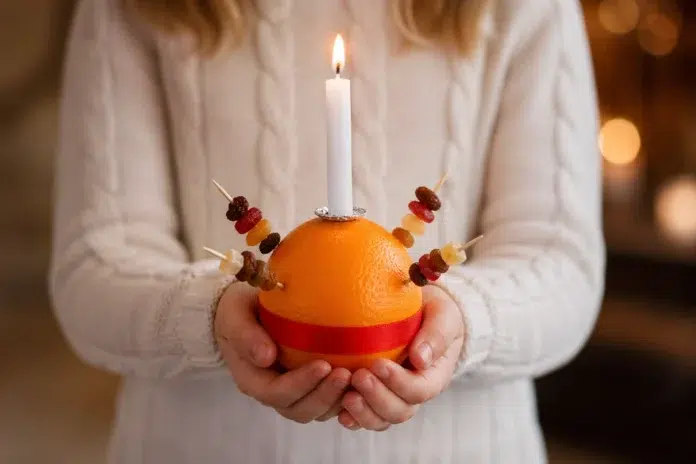
A Christingle Orange is one of those Christmas traditions that looks simple at first glance but carries far more meaning than most people expect. You might see one in a church service, a school assembly, or a family celebration during Advent, and it usually stands out right away. There is an orange, a candle, a red ribbon, and small sticks holding sweets or dried fruit. Together, those ordinary items form a visual reminder of Christian faith, hope, and generosity. Official church and charity sources describe Christingle as a celebration centered on the light of Jesus and the message of hope shared at Christmas.
For many people, the appeal of a Christingle Orange is that it makes big ideas easier to understand. Instead of hearing only words about light in darkness or God’s love for the world, children and adults can actually see those ideas represented in a single object. That is part of why the tradition has lasted so well. It is memorable, meaningful, and easy to pass on from one generation to the next.
The tradition is especially well known in the UK, though its roots go back much further to the Moravian Church in Germany. Over time, the Christingle Orange became closely associated with Advent and Christmas worship, and it later grew into a widely recognized church and charity tradition in Britain. Today, it still appears in thousands of seasonal services, connecting faith, family life, and practical support for children and young people.
What Is a Christingle Orange?
A Christingle Orange is a symbolic Christian object used during Advent, Christmas, and sometimes Epiphany services. In its modern form, it is made from an orange with a candle placed in the center, a red ribbon wrapped around the fruit, and four sticks carrying sweets, raisins, or dried fruit. Each part represents an aspect of Christian belief, which is why the object is much more than a festive decoration.
The orange usually represents the world. The candle stands for Jesus as the Light of the World. The red ribbon symbolizes the love of Christ and, in many church explanations, also points to sacrifice. The four sticks and their fruit or sweets represent the fruits of the earth and the four seasons. While wording can vary slightly between churches, the core meaning remains very consistent across official sources.
That is why the Christingle Orange works so well in teaching settings. It is visual without being complicated. A child can understand the basic symbolism quickly, while an adult can still appreciate the depth behind it. Few Christmas customs manage to be both so simple and so layered at the same time.
The History Behind the Christingle Orange
The history of Christingle begins in the Moravian congregation of Marienborn, Germany, on December 20, 1747. According to the Moravian Church of the British Province, the original idea was introduced by Johannes de Watteville during a children’s service. At that stage, the Christingle was not yet the exact orange-based version people know now. The earliest form centered on a lighted candle with a red ribbon, used to help children think about Jesus in a simple and vivid way.
That point is important because many people assume the modern Christingle Orange has always existed in its current form. It has not. The tradition developed gradually. The familiar orange, sweets, and additional symbolic details were incorporated over time as the custom spread and adapted in church life. That evolution helps explain why the tradition feels both historic and accessible. Its roots are old, but its modern expression is easy for contemporary families and schools to use.
In Britain, the tradition became much more widely known through The Children’s Society. The charity’s first Christingle service was held at Lincoln Cathedral in 1968, and that event played a major role in bringing the custom into mainstream church and school life. National Churches Trust states that the first service in Lincoln Cathedral marked a key moment in the spread of Christingle across the country.
The Children’s Society still connects the tradition to fundraising and community support today. In 2024, the charity said that more than 2,000 Christingle celebrations took place across the country, raising over £700,000 to help children and young people. That link between worship and action is one reason the Christingle Orange continues to resonate. It is not only symbolic. It is also tied to practical care.
What the Parts of a Christingle Orange Mean
The beauty of a Christingle Orange is that every part has a role. Nothing is random. Each item carries a message, which is why the object is so often used in church talks, school lessons, and family faith activities.
The orange stands for the world. It is round, bright, and full of life, making it a natural symbol for creation and the globe. This is often the first meaning children are taught because it is easy to picture. The world is held in God’s care, and the Christingle Orange starts with that simple but powerful idea.
The candle represents Jesus as the Light of the World. That image comes through strongly in Christingle services, especially when lights are dimmed and candles begin to glow across a church or school hall. The visual effect is part of the message. In the middle of darkness, light appears. That symbolism is one reason Christingle remains so memorable in Advent worship.
The red ribbon wrapped around the orange symbolizes the love of Christ and is often explained as a sign of sacrifice as well. Some churches emphasize that the ribbon goes around the whole orange to show that God’s love surrounds the world. It is a small detail, but one that often leaves a lasting impression because it turns theology into something visible and concrete.
The four sticks usually represent the four seasons, and in some explanations they can also point to the four corners of the earth. On those sticks are sweets, raisins, or dried fruit, representing the fruits of the earth and the gifts of creation. Children often notice this part first because it is colorful and eye-catching, but it carries an important message about abundance, thankfulness, and God’s provision.
When those elements are brought together, the Christingle Orange becomes a compact summary of Christian hope at Christmas. It speaks about the world, Jesus, love, creation, and joy without needing complicated language. That clarity is a major reason the tradition has stayed relevant.
Why the Christingle Orange Matters at Christmas
Christmas traditions can easily become routine. People repeat them every year without always stopping to think about what they mean. The Christingle Orange is different because it naturally invites explanation. The object almost asks to be interpreted. Why an orange? Why a candle? Why sweets? Those questions make it a strong teaching tool, especially in settings where children are learning the meaning behind Christmas customs.
It also matters because it brings participation into worship. A person does not only watch a Christingle service. They often hold the object, help make it, or light it together with others. That physical involvement makes the experience more memorable. In churches, it can help visitors feel included even if they are not familiar with formal liturgy. In schools, it gives religious education a visual and practical dimension.
The Christingle Orange also connects celebration with compassion. Through The Children’s Society, the tradition became linked to helping vulnerable children and young people, which gave the custom a strong social purpose. That means the object is not only about remembering a story from the past. It is also about expressing care in the present.
In a world where many seasonal traditions feel heavily commercialized, Christingle remains strikingly simple. It relies on everyday materials and a clear message rather than expensive presentation. That simplicity is part of its strength. It feels honest, warm, and human.
How the Christingle Orange Is Used Today
In churches, the Christingle Orange often appears in special Advent or Christmas services. These usually include hymns, prayers, a reading or short talk, and a moment when candles are lit. The visual impact of many people holding Christingles at once is one reason the tradition remains so popular. Even those who do not regularly attend church often remember that moment vividly years later.
In schools, the tradition is frequently used in assemblies or religious education lessons. Teachers and chaplains value it because it helps children connect symbols with meaning. Rather than speaking only in abstract terms about hope or light, they can show those ideas in a form children can understand.
At home, families sometimes make a Christingle Orange as part of their Advent activities. It can open the door to conversations about Christmas faith, church customs, and the reasons certain symbols still matter. In that setting, the tradition becomes personal as well as educational.
Because the practice is adaptable, different communities may use slightly different materials. Some choose dried fruit, while others use candy. Some use traditional candles, while others choose LED versions for safety. Those small variations do not change the heart of the custom. The meaning stays the same even when the materials are updated.
How to Make a Christingle Orange
Making a Christingle Orange is simple enough for schools, churches, and families, which helps explain its lasting popularity.
You need an orange, a small candle, a red ribbon, four cocktail sticks or skewers, and sweets or dried fruit. Many churches also use a small square of foil around the candle base to catch wax and reduce mess.
Start by wrapping the ribbon around the middle of the orange. Then place the candle in the top center so it stands firmly. Push the four sticks into the sides of the orange and add sweets or dried fruit to them. If you are using a real candle, check that everything feels stable before lighting it.
The making process itself often becomes part of the lesson. As each item is added, its meaning can be explained. That is one reason the Christingle Orange works so well in group settings. The activity and the teaching happen at the same time.
Safety and Modern Adaptations
Because a traditional Christingle Orange uses a lit candle, safety matters. Churches, schools, and parents often make sensible adjustments depending on the age group involved. Official and educational sources commonly note practical additions such as foil beneath the candle or the use of battery lights in some settings.
Basic safety steps are straightforward. Keep the candle upright and secure. Keep hair, sleeves, and decorations away from the flame. Do not leave a lit Christingle unattended. In classrooms or large children’s gatherings, LED candles can be a wise choice.
These updates do not weaken the tradition. They simply help it remain usable in modern spaces. In fact, the flexibility of the Christingle Orange is part of the reason it continues to thrive. Communities can preserve the symbolism while adapting the format responsibly.
Common Questions Readers Ask
One common question is whether Christingle is only a British tradition. The answer is no. It began in the Moravian Church in Germany, though it became especially well known in Britain through church and charity use.
Another question is whether the orange itself is essential. In the modern form, yes. The orange is not just a decorative base. It represents the world, which makes it central to the message. Without it, the symbol changes significantly.
People also ask whether sweets must always be used. Not necessarily. Many churches use raisins or dried fruit instead. The important point is what they represent, not the exact snack attached to the sticks.
Some readers wonder whether Christingle is only for children. It is often introduced in child-friendly ways, but the symbolism is meaningful for all ages. Adults often value the tradition just as much because of its emotional and spiritual clarity.
Why This Tradition Still Connects With Modern Families
The Christingle Orange still works today because it does not feel distant or overcomplicated. It uses ordinary materials to express something lasting. That gives it a kind of warmth that many modern holiday customs lack.
It also offers something many families and communities are looking for: a tradition that is easy to do, rich in meaning, and memorable without being expensive. In a busy season, that matters. The object is simple enough for a child to make but meaningful enough to stay with someone for years.
Its roots in the Moravian Church also give it a deeper historical dimension. The tradition is not a modern invention dressed up to look old. It has real religious and cultural history behind it, which adds to its enduring appeal.
Conclusion
A Christingle Orange is much more than a festive object used during Christmas services. It is a symbolic tradition with roots in the Moravian Church, later embraced more widely in Britain through churches, schools, and The Children’s Society. Its orange, candle, ribbon, and fruit each carry meaning, turning a simple object into a clear expression of Christian hope, light, love, and generosity.
What makes the Christingle Orange endure is its clarity. It helps children understand, gives adults something meaningful to reflect on, and brings communities together in a way that feels both gentle and memorable. Whether it appears in a cathedral, a classroom, or a family home, the Christingle Orange continues to hold its place as one of the most recognizable and heartfelt traditions of the Christmas season. sight, memory, and participation. Whether seen in a cathedral service, a school hall, or a family gathering at home, this remains one of the clearest and most meaningful visual traditions of the Christmas season.

