


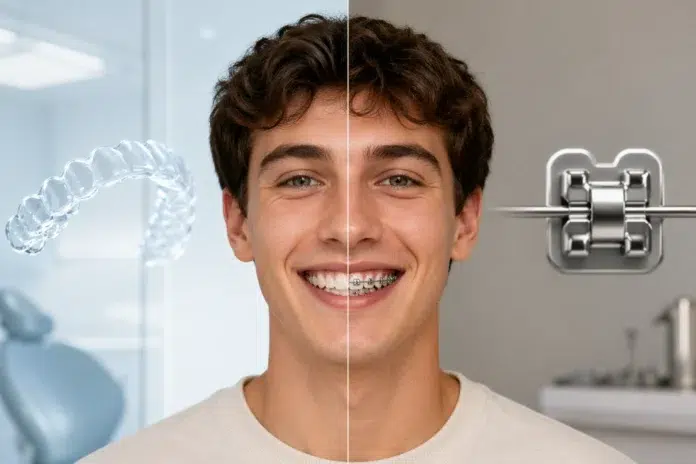
If you are trying to decide between Invisalign vs Braces, you are not alone. This is one of the most common questions people ask before starting orthodontic treatment, especially adults who want straighter teeth without making the wrong long-term choice. The truth is that Invisalign vs Braces is not just about looks. It also comes down to cost, comfort, daily habits, treatment complexity, and how predictable your final results are.
Both options can straighten teeth, improve bite problems, and make cleaning easier in the long run when treatment is planned well by a licensed orthodontist. But they do not fit every case in the same way. Fixed braces remain a strong option for more complex tooth movement, while clear aligners offer a removable, more discreet treatment path that many patients prefer for convenience and appearance. Research and professional guidance also suggest that clear aligners often feel more comfortable and may support better day-to-day oral hygiene, while braces can provide stronger control in difficult cases.
So when people compare Invisalign vs Braces, what they really want to know is simple. Which one costs less, hurts less, works faster, and gives the best result for their smile. That is exactly what this article breaks down.
What is the real difference between Invisalign and braces?
The biggest difference in Invisalign vs Braces is how they move your teeth.
Braces are fixed appliances. Brackets are attached to your teeth and connected with wires that your orthodontist adjusts over time. Because braces stay on 24/7, they keep applying force whether you are motivated or not. That makes them dependable for many complicated cases, especially when teeth need more controlled rotation, vertical movement, or bite correction. The NHS and Cleveland Clinic both describe braces as a standard treatment for crooked, crowded, gapped, or rotated teeth, as well as bite issues involving how the upper and lower teeth meet.
Invisalign uses a series of clear plastic aligners that are custom made to fit your teeth. You wear each set for a prescribed period and switch to the next one as your teeth gradually move. Unlike braces, aligners can be removed for meals, brushing, and flossing. That flexibility is a major reason why many adults lean toward Invisalign when comparing Invisalign vs Braces. But it also creates one of its biggest weaknesses. Invisalign only works as planned when you actually wear the trays for the recommended number of hours each day. Invisalign says treatment typically requires aligners to be worn for about 20 to 22 hours daily.
That means Invisalign vs Braces is also a question of lifestyle discipline. Braces stay in place and do the work automatically. Invisalign gives you more freedom, but it asks for consistency.
Invisalign vs Braces for cost
For many patients, the cost comparison is the part that matters most.
The good news is that Invisalign vs Braces is not always a huge pricing gap anymore. Invisalign states that its treatment cost is generally comparable to braces, and its own pricing materials say braces can cost about $3,000 to $7,500 without insurance. Invisalign costs vary as well depending on case complexity, treatment length, location, and provider. The AAO also notes that insurance with orthodontic coverage often applies similarly to both clear aligners and traditional braces, although exact benefits depend on the plan.
Here is a simple side-by-side look at Invisalign vs Braces on price:
| Factor | Invisalign | Braces |
|---|---|---|
| Typical private cost range | Often comparable to braces | Often $3,000 to $7,500 without insurance |
| Insurance coverage | Often covered if plan includes orthodontics | Often covered if plan includes orthodontics |
| Cost drivers | Case complexity, refinements, provider, location | Case complexity, materials, provider, location |
| Extra expenses to ask about | Lost aligners, retainers, refinements | Emergency visits, repairs, retainers |
Even when quoted prices look similar, the full financial picture can differ. Invisalign may involve replacement costs if aligners are lost or damaged. Braces may lead to occasional repair visits if brackets break or wires shift. In both cases, retainers after treatment are part of the real total cost because teeth can move back without long-term retention. The AAO and NHS both emphasize that orthodontic care is not just about active treatment. Retention matters too.
So in the Invisalign vs Braces debate, cost is usually not about which one is always cheaper. It is about which one delivers better value for your specific case.
Invisalign vs Braces for comfort
Comfort is where the conversation gets more personal.
When people compare Invisalign vs Braces, many assume both are equally uncomfortable. That is not quite true. Both treatments can cause soreness because tooth movement creates pressure. But recent systematic reviews and meta-analyses have found that patients treated with clear aligners often report better oral health-related quality of life and less pain or discomfort than those treated with fixed appliances, especially during treatment.
That makes sense in daily life. Invisalign trays do not have metal brackets or wires rubbing against the cheeks and lips. Braces can irritate soft tissue, especially after adjustments or if a wire starts poking. On the other hand, Invisalign users may feel pressure each time they move to a new tray, and some people find removing and reinserting aligners annoying in the first few weeks.
Here is where Invisalign vs Braces usually lands on comfort:
- Invisalign often feels smoother and less noticeable in the mouth.
- Braces can cause more friction and mouth soreness.
- Both can create pressure when teeth shift.
- Braces may be more frustrating when something breaks unexpectedly.
- Invisalign can be more comfortable overall, but only if trays fit well and are worn properly.
A 2022 study on adult orthodontic motivation and perception also found that invisible aligners were preferred by many patients because they were seen as less painful and caused fewer problems with eating and appearance.
So if comfort is high on your priority list, Invisalign vs Braces often leans in favor of Invisalign. Still, comfort alone should not decide treatment if your case needs the control of braces.
Invisalign vs Braces for appearance and confidence
Appearance is one of the biggest reasons adults even ask about Invisalign vs Braces in the first place.
Braces are more visible, even when ceramic options are used. Some people do not mind that. Others feel self-conscious during meetings, photos, presentations, or social events. Invisalign was built around that concern. The clear trays are designed to be discreet, which is why they appeal so strongly to working adults, college students, and image-conscious patients.
This is not just a cosmetic issue. Confidence can affect treatment satisfaction. Studies reviewing patient-reported outcomes have found that clear aligners are commonly linked with better quality-of-life scores during treatment, in part because they are less visually obvious and easier to live with socially.
That said, appearance should not override clinical reality. In the Invisalign vs Braces decision, the less visible option is not automatically the better treatment.
Invisalign vs Braces for eating and daily life
Daily routine is where these two treatments really start to feel different.
With braces, you have to be careful about sticky, hard, or crunchy foods because they can damage brackets and wires. The AAO notes that aligners remove that issue because you take them out before meals, and the NHS explains that fixed braces come with extra care requirements and cleaning responsibilities.
With Invisalign, you can eat what you want, but there is a catch. You must remove the aligners before every meal or snack and brush before putting them back in. That sounds easy, but in real life it can become tiring, especially if you snack often, drink coffee throughout the day, or have a busy work schedule.
So in Invisalign vs Braces, lifestyle goes both ways:
Invisalign may feel easier if:
- You want no food restrictions
- You care about appearance in public
- You are disciplined enough to wear trays 20 to 22 hours a day
- You can keep up with brushing after meals
Braces may feel easier if:
- You do not want to think about removing trays
- You are worried about forgetting or losing aligners
- You prefer a fixed system that keeps working all day
- You are okay adjusting your food choices for a while
Invisalign vs Braces for oral hygiene
This part matters more than many people realize.
Orthodontic treatment can improve long-term oral health by making teeth easier to clean and helping correct bite problems. But during treatment, your oral hygiene routine becomes more important, not less. Braces create extra surfaces where plaque can collect, and both the ADA and NHS-based orthodontic guidance stress careful brushing and cleaning during treatment to reduce the risk of decay, gum irritation, and enamel problems. NIDCR also recommends brushing twice daily with fluoride toothpaste and cleaning between teeth once a day.
This is one of the clearest advantages in Invisalign vs Braces. Because aligners are removable, you can brush and floss more normally. The AAO specifically highlights removability as a benefit for oral hygiene, and multiple reviews have found better periodontal or oral-health-related outcomes with clear aligners compared with fixed appliances in many settings.
Still, Invisalign is not automatically healthier. If you put trays back on without brushing, or if sugary drinks are trapped under aligners, problems can still develop. Clean aligners and clean teeth have to go together.
When weighing Invisalign vs Braces, patients who already struggle with flossing should be honest with themselves. Braces demand more effort. Invisalign demands more consistency.
Invisalign vs Braces for treatment time
Treatment time is one of the most misunderstood parts of Invisalign vs Braces.
Some marketing claims make Invisalign sound dramatically faster. In reality, treatment speed depends on the type and severity of your orthodontic problem, your biology, and how well you follow instructions. Invisalign says some patients may start seeing changes in as little as six months, and adult treatment is often around 12 to 18 months on average. But a recent review in PubMed found only low evidence that treatment duration with clear aligners is similar to fixed appliances in mild to moderate crowding cases. That is a careful way of saying the answer is not one-size-fits-all.
Braces often run in the 12 to 24 month range, and more complex surgical or skeletal cases can take longer. Mayo Clinic notes that braces placed before jaw surgery often remain on for 12 to 18 months just to prepare the teeth for surgery.
So the honest answer in Invisalign vs Braces is this:
- Mild to moderate cases may be treated in similar timeframes.
- Invisalign can move quickly in simpler cases when wear time is excellent.
- Braces may be more predictable in complex cases because they do not depend on patient compliance the same way.
- Missed wear time can slow Invisalign more than many patients expect.
If speed matters to you, ask your orthodontist for a case-specific estimate, not a generic promise.
Invisalign vs Braces for results
The final result is what matters most. Not the tray, not the brackets, not the trend.
Both Invisalign and braces can produce excellent results when the case is well diagnosed and properly managed. Clear aligners are highly effective for many mild to moderate cases and are increasingly used in adults and teens. But reviews of the evidence still suggest that braces often provide stronger control for more complex tooth movements and certain bite corrections. Case complexity and compliance are major deciding factors.
This is where the Invisalign vs Braces conversation becomes more clinical than cosmetic.
Braces may be better for:
- Severe crowding
- Significant rotations
- Complex bite correction
- Cases needing precise vertical tooth movement
- Patients unlikely to wear aligners as instructed
Invisalign may be better for:
- Mild to moderate crowding or spacing
- Adults who want a discreet option
- Patients with strong self-discipline
- People who want removable treatment for meals and cleaning
In other words, the best results in Invisalign vs Braces often depend less on the brand and more on the case selection.
Which is better for adults and teens?
Adults are a major part of the orthodontic market now. The AAO reported in 2025 that about one in three orthodontic patients is over age 18, showing how normal adult treatment has become.
For adults, Invisalign vs Braces often comes down to appearance, work life, social comfort, and convenience. Many adults prefer Invisalign because it feels less visible and more compatible with professional settings. Adults also tend to be more motivated and compliant, which helps aligner treatment succeed.
For teens, the answer is less predictable. Some teens do great with Invisalign. Others lose trays, forget wear time, or remove them too often. Braces can be easier for families who want a treatment option that does not depend so heavily on day-to-day discipline.
Practical questions to ask before choosing
Before deciding on Invisalign vs Braces, ask these questions during your consultation:
- Is my case mild, moderate, or complex?
- Will clear aligners achieve the same result as braces in my bite?
- How long is treatment likely to take for me?
- What is the full cost, including retainers and possible refinements?
- How often will I need follow-up visits?
- What happens if I lose aligners or break a bracket?
- Which option fits my cleaning habits and schedule better?
These questions usually reveal the right answer faster than marketing pages do.
Final thoughts on Invisalign vs Braces
Choosing between Invisalign vs Braces is not really about picking the more modern option or the more traditional one. It is about choosing the system that fits your teeth, your bite, your budget, and your habits.
If you want a more discreet treatment, fewer food restrictions, and easier brushing and flossing, Invisalign can be an excellent fit. If your case is more complex, or if you want a fixed option that does not rely on daily discipline in the same way, braces may be the smarter path. Both can deliver strong results when treatment is planned by an orthodontic professional and followed carefully.
The best choice in Invisalign vs Braces is the one that can realistically get you to a healthy, stable smile, not just the one that sounds more appealing at first. And once treatment ends, retention still matters, because teeth can shift after orthodontic work if retainers are not worn as advised. In the last stage of your decision, it also helps to understand the basics of orthodontic treatment, because the method matters less than whether it fits the problem well.
A smart Invisalign vs Braces decision starts with honesty. Be honest about your budget, honest about your routine, and honest about whether you will really wear aligners as instructed. That is usually what separates a smooth treatment from a frustrating one.
FAQs
Is Invisalign cheaper than braces?
Not always. In many private practices, Invisalign and braces are priced in a similar range. The final cost depends more on case complexity, provider, and treatment length than on the label alone.
Does Invisalign hurt less than braces?
Research suggests many patients report less pain and a better treatment experience with clear aligners than with fixed braces, though both options can cause pressure and soreness.
Do braces work better than Invisalign?
For many mild to moderate cases, both can work very well. Braces may have an advantage in more complex movements and bite corrections, especially when patient compliance is a concern.
Which is faster, Invisalign or braces?
Either can be faster depending on the case. Invisalign may move quickly in simple cases, but braces are often more predictable in complex ones because they stay on full time.
Is Invisalign better for adults?
It can be, especially for adults who want a discreet option and can wear the aligners consistently. That is one reason adult orthodontic treatment has grown so much in recent years.

