


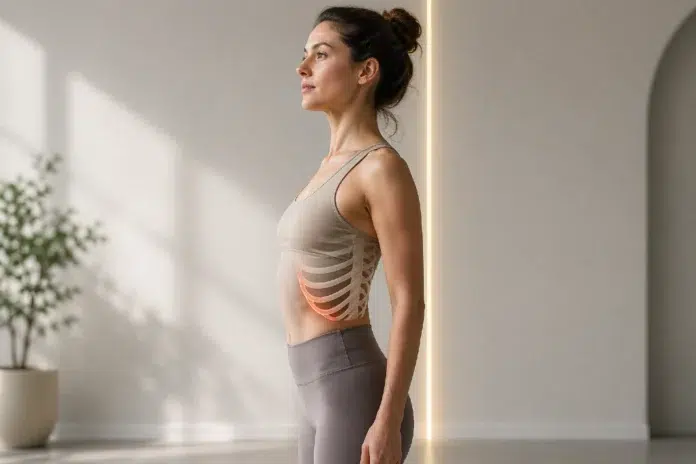
Flared Ribs can make the lower part of the rib cage stick out more than usual, especially when standing, lying down, or raising the arms overhead. For many people, it is not painful at first. It may simply look like the ribs are “popping out” near the upper stomach. Over time, though, rib flare can be linked with posture habits, breathing patterns, core weakness, back discomfort, and poor body alignment.
The good news is that in many cases, Flared Ribs can improve with better awareness, safer breathing habits, gentle strengthening, and consistent posture work. It is not about forcing your ribs down all day. It is about teaching your body to move, breathe, and support itself in a more balanced way.
This article breaks down what rib flare means, why it happens, what signs to watch for, and how to improve posture in a realistic, safe way.
What Are Flared Ribs?
Flared Ribs describe a position where the lower ribs angle outward or upward more than expected. Instead of sitting comfortably over the pelvis, the front of the rib cage may appear lifted, widened, or pushed forward.
This can happen on both sides or just one side. Some people notice it more when they look in the mirror from the side. Others only see it during exercise, when lying flat, or when trying to keep a “straight” posture.
The ribs are not just bones sitting still in the chest. They move with breathing, posture, spinal position, shoulder motion, and abdominal pressure. The rib cage helps protect organs, supports breathing, and works closely with the diaphragm, spine, pelvis, and core muscles. According to Physio-Pedia, the ribs form the main structure of the thoracic cage and play an important role in respiration.
So when the lower ribs flare outward, it often reflects how the whole trunk is being used, not just the ribs themselves.
Why Do Flared Ribs Happen?
There is not one single cause. Flared Ribs may come from posture, muscle imbalance, breathing mechanics, genetics, pregnancy, training habits, or a combination of factors.
Some people naturally have a rib cage shape that is more prominent. Others develop rib flare because their body has learned to hold the chest, spine, and pelvis in a certain position for years.
Common Causes of Flared Ribs
| Cause | How It May Affect Rib Position |
|---|---|
| Poor posture | Can lift the chest and arch the lower back |
| Weak deep core muscles | Makes it harder to control the rib cage |
| Tight lower back muscles | May pull the spine into an extended position |
| Shallow chest breathing | Keeps the upper chest overactive |
| Pregnancy or postpartum changes | Can stretch the abdominal wall and shift rib position |
| Genetics | Some rib cage shapes are naturally more visible |
| Exercise form issues | Overarching during lifts can encourage rib flare |
| Stress and tension | May change breathing and chest position |
Physical therapy sources often connect rib flare with posture, breathing habits, core control, injury history, pregnancy, and genetics.
Flared Ribs and Posture: The Connection
Posture is one of the biggest reasons people notice rib flare. When someone stands with the chest lifted high, lower back arched, and pelvis tilted forward, the lower ribs often move upward and outward.
This position is sometimes mistaken for “good posture” because the person looks upright. But real posture is not about puffing the chest out. It is about stacking the rib cage, spine, and pelvis so the body can breathe and move without unnecessary tension.
A common pattern looks like this:
The lower back arches.
The pelvis tips forward.
The chest lifts.
The lower ribs flare.
The abdominal wall loses tension.
The neck and shoulders may feel tight.
This does not mean your body is damaged. It means your body may be using one area too much and another area too little.
Mayo Clinic notes that strong core muscles include the abdominal muscles, back muscles, and muscles around the pelvis, and that strengthening these muscles can make many physical activities easier.
That matters because rib position is strongly connected to core control.
Signs You May Have Flared Ribs
Flared Ribs can look and feel different from person to person. Some people notice only a cosmetic change. Others feel tightness, discomfort, or trouble keeping good exercise form.
Common signs include:
The lower ribs stick out when standing.
The ribs become more visible when lying on the back.
The chest feels lifted even when trying to relax.
The lower back arches easily.
The stomach pushes forward even at a healthy weight.
You struggle to keep your ribs down during planks, push-ups, or overhead exercises.
You feel tightness around the upper abdomen or lower chest.
You breathe more into your chest than your belly or sides.
One side of the rib cage appears more prominent.
Not every visible rib is a problem. Some people have a naturally lean body type or a rib shape that shows more clearly. The key question is whether the rib position comes with discomfort, breathing issues, posture problems, or movement limitations.
Are Flared Ribs Dangerous?
In many cases, Flared Ribs are not dangerous. They are often a posture and movement pattern rather than a serious medical condition.
However, rib flare should not be ignored if it comes with pain, breathing trouble, chest pressure, sudden swelling, injury, or symptoms that feel unusual. Cleveland Clinic explains that visible rib-related breathing changes, such as intercostal retractions, can sometimes happen when airways are narrowed or blocked and may need urgent medical care.
Rib flare itself is different from emergency breathing distress, but it is important to know the difference.
Seek medical advice if you have:
Sudden chest pain
Trouble breathing
Pain after a fall or impact
Rib pain that does not improve
Dizziness or bluish lips
Severe one-sided rib changes
Numbness, tingling, or weakness
Pain with deep breaths
A health professional can check whether the issue is posture-related, muscular, skeletal, respiratory, or something else.
Flared Ribs and Breathing Patterns
Breathing plays a major role in rib position. When breathing is relaxed and efficient, the rib cage expands in multiple directions. The diaphragm moves well, the lower ribs can widen gently, and the abdomen and back share the pressure.
But many people breathe mostly into the upper chest. This can happen because of stress, poor posture, long sitting hours, tight clothing, anxiety, intense training habits, or simply years of not paying attention to breathing.
When the upper chest does most of the work, the lower ribs may stay lifted. Over time, this can make rib flare more noticeable.
Physio-Pedia explains that respiratory muscles, including the diaphragm and intercostals, contribute to postural stability by helping regulate pressure inside the chest and abdomen.
That is why improving breathing is not just about getting more air. It can also help the body find better alignment.
Flared Ribs and Core Weakness
The core is not just the visible “six-pack” muscle. It includes deeper muscles that help control the spine, pelvis, and rib cage. These muscles help manage pressure during breathing, lifting, walking, bending, and standing.
When the deep core is weak or poorly coordinated, the ribs may flare because the body has less control over the front of the trunk.
Common signs of poor core control include:
Arching the back during exercises
Holding the breath during movement
Struggling to keep the ribs down
Feeling pressure in the lower back during core exercises
Having a belly-dominant posture even without excess body fat
Getting tired quickly while standing upright
This is why endless crunches are not always the answer. In fact, some people with rib flare make the problem worse by doing abdominal exercises with poor form. Better options often include breathing-based core work, dead bugs, heel taps, modified planks, and exercises that teach the ribs and pelvis to work together.
Flared Ribs After Pregnancy
Pregnancy can change rib position because the body makes room for the growing baby. The rib cage may widen, the abdominal wall stretches, and breathing mechanics shift. After birth, some people notice the lower ribs still feel wider or more lifted than before.
Postpartum rib flare may also be connected with diastasis recti, weak deep core muscles, tight hip flexors, or an anterior pelvic tilt.
The goal after pregnancy is not to “snap back” quickly. It is to rebuild strength gradually. A postpartum physical therapist can help with breathing, pelvic floor coordination, abdominal strength, and safe exercise progressions.
Gentle work is usually better than aggressive core training early on.
Flared Ribs in Fitness and Exercise
Many people first notice Flared Ribs during workouts. It may show up during overhead presses, pull-ups, push-ups, planks, yoga poses, bridges, or even running.
A common issue is overextension. This means the person arches the lower back and lifts the ribs to create the illusion of more mobility or strength.
For example, during an overhead press, someone may not have enough shoulder mobility or core control. To get the weight overhead, they arch their back and flare the ribs. It works for the movement in the moment, but it places extra stress on the lower back and reduces trunk stability.
During planks, rib flare can happen when the core loses tension and the lower back dips. During yoga backbends, it can happen when the movement comes more from the lower ribs and lower back than from balanced spinal mobility.
Mayo Clinic notes that back exercises can help stretch and strengthen the muscles that support the back, and exercise often helps ease back pain and prevent further discomfort.
For rib flare, the quality of movement matters more than intensity.
Simple Self-Check for Flared Ribs
You can do a basic posture check at home. This is not a diagnosis, but it can help you understand your alignment.
Stand sideways in front of a mirror.
Relax your shoulders.
Do not force your chest up.
Notice whether your lower ribs stick forward.
Now gently exhale.
Let your front ribs soften down without slouching.
Check whether your lower back feels less arched.
Next, raise both arms overhead.
Watch whether your ribs pop forward as your arms lift.
If your ribs flare every time you move your arms, it may mean your body is borrowing movement from your lower back and rib cage instead of using shoulder mobility and core control.
How to Improve Flared Ribs Naturally
Improving rib flare usually means training the body to stack better, breathe better, and move better. It is not about pushing your ribs down with force. That can create more tension.
Start with small daily habits. The body responds well to repeated signals.
Flared Ribs Posture Tips That Actually Help
1. Learn the Rib and Pelvis Stack
Think of your rib cage as one bowl and your pelvis as another bowl. In better posture, the bowls are stacked over each other.
Try this:
Stand tall but relaxed.
Place one hand on your lower ribs and one hand on your pelvis.
Gently exhale.
Let the front ribs soften down.
Keep your pelvis neutral instead of tipping too far forward.
Avoid squeezing your glutes too hard.
This should feel balanced, not stiff.
A good cue is: “Ribs over hips.”
2. Stop Over-Lifting the Chest
Many people are told to “stand up straight,” so they lift the chest aggressively. This can make Flared Ribs more obvious.
Instead, think:
Long spine
Soft ribs
Relaxed shoulders
Chin slightly tucked
Weight balanced through the feet
Good posture should feel calm and sustainable. If you have to hold it with effort all day, it is probably too forced.
3. Practice 360-Degree Breathing
This type of breathing teaches your rib cage to expand gently to the front, sides, and back.
Try this:
Lie on your back with knees bent.
Place your hands around the lower ribs.
Inhale through the nose.
Feel the ribs expand sideways and slightly backward.
Exhale slowly through the mouth.
Let the ribs soften down naturally.
Repeat for 5 to 8 breaths.
Do not push your belly out as hard as possible. Think of quiet expansion, not big dramatic breathing.
4. Strengthen the Deep Core
Deep core exercises can help control rib position. Start simple.
Good beginner exercises include:
Dead bug holds
Heel taps
Glute bridges
Side planks from knees
Bird dog
Wall presses
Modified planks
Mayo Clinic lists bridge and plank variations as core-strengthening movements that work several muscles, including the abdomen, back, and pelvis.
The key is to keep the ribs from popping up during each exercise.
5. Stretch Tight Areas Carefully
Rib flare may be worse when certain areas are tight. These can include the lower back, hip flexors, lats, chest, and intercostal muscles.
Helpful mobility work may include:
Child’s pose breathing
Cat-cow movement
Thoracic rotations
Hip flexor stretch
Lat stretch against a wall
Gentle chest opener
Avoid forcing deep backbends if they make your ribs flare more.
6. Improve Shoulder Mobility
When shoulder movement is limited, the body may compensate by arching the back and flaring the ribs.
Try this simple wall test:
Stand with your back near a wall.
Keep ribs softly down.
Raise your arms overhead.
Notice if your lower back arches or ribs lift.
If they do, work on shoulder mobility slowly. Wall slides, thoracic extension drills, and controlled overhead reaches can help.
7. Adjust Sitting Habits
Long sitting can encourage poor rib and pelvis alignment. You do not need perfect posture every second, but you should change positions often.
Try:
Keep feet flat on the floor.
Avoid sitting on the tailbone all day.
Let shoulders relax.
Keep screen height comfortable.
Stand up every 30 to 60 minutes.
Take a few slow breaths before returning to work.
Small posture resets add up.
Best Exercises for Flared Ribs
Here are simple exercises that may help improve rib control and posture.
Exercise 1: Supine Breathing Reset
Lie on your back with knees bent.
Place one hand on your chest and one hand on your lower ribs.
Inhale slowly through the nose.
Exhale fully through the mouth.
Let your ribs move down gently.
Repeat for 1 to 2 minutes.
This helps reduce chest-dominant breathing.
Exercise 2: Dead Bug
Lie on your back with knees bent at 90 degrees.
Bring arms toward the ceiling.
Exhale and soften the ribs down.
Slowly lower one heel or extend one leg.
Return with control.
Switch sides.
Do 6 to 10 reps per side.
If your back arches, make the movement smaller.
Exercise 3: Glute Bridge With Rib Control
Lie on your back with knees bent.
Exhale gently.
Keep ribs soft.
Lift hips without pushing the ribs upward.
Pause at the top.
Lower slowly.
Do 8 to 12 reps.
The bridge helps connect glutes, core, and pelvis.
Exercise 4: Wall Reach Breathing
Stand facing a wall.
Place both hands on the wall.
Slightly round your upper back.
Exhale and reach gently through the hands.
Feel the ribs soften.
Breathe into the back and sides of the rib cage.
Hold for 5 slow breaths.
This can be useful for people who feel stuck in a chest-lifted posture.
Exercise 5: Bird Dog
Start on hands and knees.
Keep your spine neutral.
Exhale gently.
Extend opposite arm and leg.
Do not let ribs drop or flare.
Return slowly.
Do 6 to 8 reps per side.
This teaches trunk stability while the limbs move.
Exercises to Be Careful With
Some exercises are not bad, but they can make rib flare worse if done without control.
Be careful with:
Heavy overhead presses
Deep backbends
Aggressive cobra pose
Poorly controlled planks
High-volume crunches
Pull-ups with excessive arching
Heavy squats with rib flare
Bench press with extreme rib lift
If your ribs flare during an exercise, reduce the range, lower the weight, slow down, and focus on breathing.
Daily Habits That Support Better Rib Position
Posture is not built only in workouts. It is shaped by daily habits.
Try these small changes:
Exhale fully before hard lifts.
Avoid holding your breath during simple tasks.
Keep ribs relaxed while walking.
Do not stand with weight always on one hip.
Use a supportive chair when working long hours.
Take slow breathing breaks during stress.
Sleep in a position that does not force your back into a strong arch.
Notice when you are “puffing up” your chest.
A better rib position should eventually feel natural, not forced.
When to See a Physical Therapist or Doctor
If rib flare is mild and painless, you may start with posture and breathing work. But professional help is a smart choice when symptoms are persistent, painful, or one-sided.
See a qualified clinician if:
One side is much more flared than the other.
You have ongoing back, rib, or chest pain.
You feel short of breath.
The rib change happened suddenly.
You had an injury.
You are postpartum and feel weak through the core.
Exercises make symptoms worse.
You suspect scoliosis or another spinal issue.
A physical therapist can assess your posture, breathing, spinal mobility, shoulder motion, core strength, and pelvis position. This is much more useful than guessing from a mirror.
Common Myths About Flared Ribs
Myth 1: Flared Ribs Always Mean Something Is Wrong
Not always. Some people naturally have more visible ribs because of body shape, genetics, or low body fat. It becomes more important when it affects movement, comfort, breathing, or confidence.
Myth 2: You Can Fix Rib Flare by Forcing the Ribs Down
Forcing the ribs down all day can create tension. The better approach is to improve breathing, core control, and rib-pelvis alignment.
Myth 3: More Ab Exercises Will Fix Everything
Not necessarily. If you do core exercises with poor form, your ribs may keep flaring. Quality matters more than quantity.
Myth 4: Rib Flare Only Happens to Athletes
Anyone can develop it. Office workers, new parents, teens, gym beginners, dancers, and people who sit for long hours may all notice rib flare.
Myth 5: Flared Ribs Cannot Improve
Many posture-related cases can improve with consistent training. Structural rib shape may not completely change, but control, appearance, comfort, and movement can often get better.
Real-World Example: Desk Worker With Rib Flare
Imagine someone who works at a desk for eight hours a day. They sit with the lower back arched, chest lifted, and shoulders tense. At the gym, they do planks, but their lower back dips and ribs pop out. They also breathe mostly into the upper chest when stressed.
In this case, the problem is not just the ribs. It is a full-body pattern.
A better plan would include:
Breathing resets
Core control drills
Hip flexor stretching
Glute strengthening
Better sitting breaks
Lighter exercise loads for a few weeks
Over time, the ribs may appear less prominent because the body learns to stack and stabilize better.
Real-World Example: Postpartum Rib Flare
A postpartum person may notice that the lower ribs look wider after pregnancy. They may also feel weak through the abdomen and struggle with planks or sit-ups.
Jumping straight into intense ab workouts may not help. A better starting point is breathing, pelvic floor coordination, deep core activation, walking, and gradual strengthening.
This is where a postpartum physical therapist can be especially helpful.
Can Flared Ribs Be Fully Corrected?
The answer depends on the cause.
If Flared Ribs are mostly related to posture, breathing, and muscle control, they may improve noticeably. If they are related to natural bone structure, genetics, or a long-standing skeletal shape, the appearance may not fully disappear.
Still, even when structure does not change much, function can improve. You may feel better, move better, breathe better, and have less tension in the back and chest.
The realistic goal is not perfection. The goal is better alignment, better control, and more comfort.
How Long Does It Take to Improve Rib Flare?
Mild posture-related rib flare may start improving within a few weeks of consistent work. More noticeable changes often take a few months.
Progress depends on:
How long the pattern has been present
Exercise consistency
Breathing habits
Core strength
Mobility restrictions
Pregnancy or postpartum history
Training technique
Daily posture habits
Doing five minutes every day is often more effective than doing one long session once a week.
Frequently Asked Questions About Flared Ribs
What causes Flared Ribs?
Flared Ribs can be caused by posture habits, weak core muscles, shallow breathing, pregnancy, genetics, tight lower back muscles, poor exercise form, or muscle imbalance. In many people, several factors happen together.
Can Flared Ribs cause back pain?
They may contribute to back discomfort if they are part of a posture pattern that includes an arched lower back, weak core control, and poor rib-pelvis alignment. The ribs themselves may not be the only cause.
Are Flared Ribs genetic?
They can be. Some people naturally have a rib cage shape that appears more prominent. However, posture and breathing habits can make rib flare look better or worse.
Can exercise fix Flared Ribs?
Exercise may help when rib flare is related to posture, breathing, and core weakness. The best exercises usually focus on breathing control, deep core strength, glutes, shoulder mobility, and spinal alignment.
Should I wear a brace for Flared Ribs?
A brace should not be the first choice unless recommended by a healthcare professional. Bracing without proper guidance may reduce muscle activity or create dependence. Movement-based correction is usually more useful for posture-related rib flare.
Are Flared Ribs the same as scoliosis?
No. Rib flare and scoliosis are different. However, scoliosis can sometimes affect rib cage appearance, especially if one side looks more prominent. If your rib flare is strongly one-sided, it is worth getting assessed.
Conclusion
Flared Ribs are often a sign that the rib cage, pelvis, spine, breathing, and core muscles are not working together as well as they could. For some people, it is mostly a natural body shape. For others, it is linked with posture habits, weak core control, shallow breathing, pregnancy changes, or exercise technique.
The best way to improve Flared Ribs is not to force your ribs down or chase perfect posture. Start with simple breathing, better rib-pelvis stacking, gentle core strength, glute work, shoulder mobility, and small daily posture resets. These habits can make your body feel more supported and balanced.
If you have pain, breathing difficulty, sudden changes, or one-sided rib prominence, speak with a qualified healthcare professional. Your rib cage is part of the broader thoracic cage, so it deserves a careful, whole-body approach rather than quick fixes.
With patience and consistent practice, many people can improve the way Flared Ribs look and feel while building stronger, more comfortable posture.

