


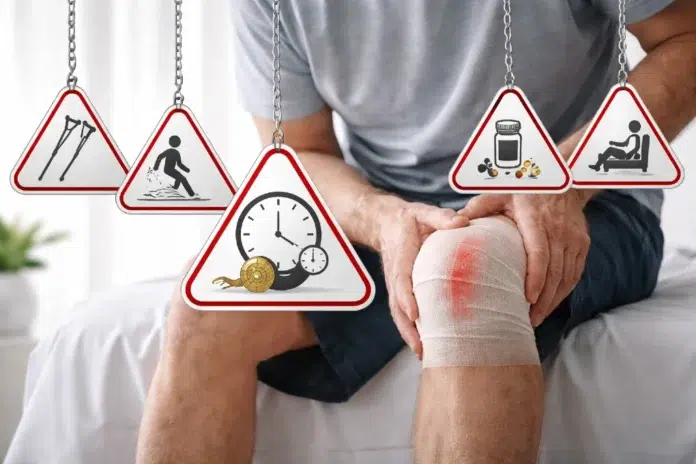
Knee replacement can be life changing, but the surgery is only part of the story. What happens in the first few days, weeks, and months after the operation has a huge impact on how smoothly you recover. That is why understanding the Top 5 Mistakes After Knee Replacement matters so much. Many people do well after surgery, yet recovery can stall when patients push too hard, move too little, skip rehab, ignore swelling, or miss warning signs that need fast medical attention.
The good news is that most setbacks are preventable. A total knee replacement is widely considered a safe and effective procedure for relieving pain and restoring function, but full recovery still takes time, consistent rehab, and smart day to day choices. AAOS notes that recovery takes several months, and NHS guidance highlights gradual progress with walking aids, exercises, and returning to daily activity over time.
If you are trying to protect your new knee and get back to normal life faster, these are the mistakes worth avoiding.
Why Recovery After Knee Replacement Is Easy to Misjudge
One reason people struggle after surgery is simple: they expect recovery to be linear. It rarely is.
You may feel better one day and more swollen the next. You may walk farther this week, then need more rest the week after. AAOS says mild to moderate swelling can last for 3 to 6 months, and a full recovery takes several months, so it is normal for healing to feel slower than expected.
Another issue is expectation. Many patients go into surgery thinking the hard part ends in the operating room. In reality, the new joint needs time, movement, strength work, and patience. A 2023 systematic review found the average dissatisfaction rate after total knee arthroplasty was about 10%, with unmet expectations, stiffness, persistent pain, and complications playing a major role.
That is exactly why the Top 5 Mistakes After Knee Replacement are so important. These are not small errors. They are the habits that often separate steady progress from a frustrating recovery.
A Quick Look at the Top 5 Mistakes After Knee Replacement
| Mistake | Why it slows recovery | Better approach |
|---|---|---|
| Doing too much too soon | Increases pain, swelling, and irritation | Build activity gradually |
| Doing too little | Raises stiffness and clot risk, weakens muscles | Walk and exercise as advised |
| Skipping physical therapy | Limits range of motion and strength | Stay consistent with rehab |
| Ignoring swelling and pain patterns | Can hide overuse or poor pacing | Use elevation, ice, and adjust activity |
| Missing warning signs | Delays treatment for infection or blood clots | Contact your care team quickly |
Mistake #1: Doing Too Much Too Soon
This is one of the most common recovery mistakes, especially in people who are motivated and eager to “get back to normal.” They start walking longer distances too early, take on stairs repeatedly, stand too long in the kitchen, or assume more activity always means faster healing.
Usually, it backfires.
A knee replacement leaves tissues irritated and healing. When you overload the joint too early, your knee often responds with more swelling, more pain, and less motion. That creates a cycle where you push, swell up, then can barely bend or straighten the knee the next day. AAOS specifically notes that even after recovery, patients are advised to avoid activities that place excessive stress on the new knee, including high impact activity.
A better mindset is this: recovery is not a test of toughness. It is a test of judgment.
That means pacing your day. If you had a busy morning, your afternoon may need more elevation and rest. If you walked farther than usual, you may need to cut back later. Progress should feel steady, not punishing.
A simple real world example makes this clear. One patient may feel great at two weeks and decide to clean the house, cook dinner, and take two long walks in one day. By evening, the knee is hot, swollen, tight, and painful. Another patient does shorter walks, prescribed exercises, and planned rest breaks. The second patient often regains motion faster because the knee stays calmer.
Mistake #2: Moving Too Little Because You Are Afraid of Pain
The opposite problem is just as damaging.
Some people become so worried about pain, falling, or damaging the implant that they barely move. They stay in bed too long, avoid walking, skip gentle bending, or keep the leg in one position for hours. That can slow healing in a different way.
After surgery, movement matters. NHS guidance advises getting up and walking around for 5 minutes every hour to help prevent blood clots, and AAOS emphasizes regular exercise plus gradual return to activity to restore strength and mobility. NICE also states that patients should receive individualized postoperative rehabilitation advice before discharge.
Too little movement can lead to:
- Increased stiffness
- Reduced circulation
- Weaker muscles around the knee
- Lower confidence with walking
- Higher risk of blood clots
The key is not aggressive activity. The key is regular, appropriate activity.
That usually means short walks, ankle pumps, knee straightening work, gentle bends, and the home program your therapist gives you. You do not need marathon effort. You need frequent, sensible movement.
A lot of patients say, “I thought resting more would help.” Some rest is important, especially in the first phase. But total rest is rarely the answer after knee replacement. Smart motion is part of the treatment.
Mistake #3: Treating Physical Therapy Like an Optional Extra
If there is one theme every orthopedic team repeats, it is this: the knee replacement gives you the mechanical opportunity to move better, but rehab teaches your body how to use it.
AAOS says regular exercise to restore strength and mobility is essential, and their exercise guidance notes that patients may be advised to exercise for 20 to 30 minutes daily, or even 2 to 3 times a day, plus walking during early recovery.
Yet many people fall into one of two traps. They either skip therapy sessions and home exercises because they feel tired or sore, or they attend therapy but do not follow through at home. Both can delay recovery.
This is where the Top 5 Mistakes After Knee Replacement become very practical. Missing rehab does not always cause an immediate disaster, but it often shows up later as lingering stiffness, weakness, difficulty going downstairs, or trouble getting fully straight.
The early recovery window matters. If your knee becomes very stiff, some patients may need additional treatment. AAOS notes that after manipulation under anesthesia, continuing physical therapy is very important to prevent the stiffness from returning.
That does not mean every patient must perform every exercise perfectly every day. It means consistency matters more than intensity.
A good routine usually looks like this:
- Follow your physical therapist’s plan instead of creating your own
- Focus on both bending and straightening the knee
- Keep exercises regular, not random
- Tell your therapist when an exercise causes unusual pain or a sharp setback
- Keep showing up, even when progress feels slower than you hoped
The people who recover best are not always the toughest. Often, they are simply the most consistent.
Mistake #4: Ignoring Swelling, Poor Pain Control, or Bad Positioning
Many patients think swelling is just something they have to endure. Some swelling is normal, yes. But unmanaged swelling can make the knee feel tight, painful, and hard to move. When that happens, exercises become harder and walking quality drops.
AAOS says moderate to severe swelling is common in the first days and weeks, with mild to moderate swelling sometimes lasting 3 to 6 months. They recommend elevation and ice, and note that compression stockings may help. They also warn that new or severe swelling can be a sign of a blood clot.
This is where recovery becomes more strategic. If your knee is constantly angry, it is often a sign your balance is off. Maybe you are on your feet too long. Maybe you are not icing enough. Maybe you are letting pain build until you stop moving well.
Poor positioning can also make things worse. Some hospital rehab guidance warns against resting with the knee bent for long periods because that can make it harder for the knee to fully straighten over time.
A more effective plan usually includes:
- Elevating the leg at regular intervals
- Using ice as directed by your surgical team
- Taking pain medication exactly as prescribed
- Avoiding long periods with the knee stuck in a bent position
- Noticing patterns, such as swelling after too much standing or walking
This matters because pain control is not about comfort alone. It affects how well you sleep, how well you exercise, how confident you feel walking, and how much motion you regain.
Mistake #5: Brushing Off Red Flags That Need Medical Attention
Some symptoms are part of normal recovery. Others are not.
This is one of the most serious items on the list of the Top 5 Mistakes After Knee Replacement because waiting too long can turn a treatable problem into an emergency.
AAOS reports that about 1% of joint replacement patients develop an infection after surgery. CDC guidance explains that symptoms of a dangerous blood clot problem can include swelling, redness or discoloration, difficulty breathing, chest pain, coughing up blood, fainting, or lightheadedness.
Call your surgeon or seek urgent care right away if you notice:
- Fever with worsening knee pain or drainage
- Increasing redness spreading around the incision
- New or severe calf swelling
- Sudden shortness of breath
- Chest pain
- Coughing up blood
- Fainting or feeling like you may pass out
People sometimes ignore these signs because they assume all pain and swelling are normal after surgery. That assumption can be dangerous.
Trust your instincts. If something feels significantly different from your usual recovery pattern, speak up quickly.
What Patients Often Get Wrong About Walking, Rest, and Daily Life
A lot of recovery confusion comes from everyday activities, not just formal exercise.
Walking is good, but limping through long distances with poor form is not. Rest is helpful, but staying inactive for hours is not. Household chores may feel light, but repeated standing, turning, and carrying can inflame the knee more than people expect.
NHS guidance says patients often use crutches or walking sticks at first and may try walking without an aid after about 6 weeks if they feel ready. They also say driving usually needs to wait at least 6 weeks after a total knee replacement, subject to medical advice.
That tells you something important: recovery has stages. There is no prize for rushing past them.
If you want your new knee to serve you well long term, think in terms of building tolerance. Start with safe basics. Add activity gradually. Let swelling and pain levels tell you whether your current load is appropriate.
How to Recover Smarter Instead of Harder
Avoiding the Top 5 Mistakes After Knee Replacement is not about perfection. It is about making enough good decisions, often enough, to keep healing on track.
A smarter recovery plan usually includes a few simple principles.
First, respect the basics. Take your medications as prescribed, do your exercises, use your walking aid correctly, and keep your follow up appointments.
Second, pace your activity. A knee that becomes more swollen and tighter every evening is usually telling you something.
Third, protect range of motion. Bending matters, but straightening matters too. Patients often underestimate how important full extension is for smooth walking.
Fourth, communicate early. If pain suddenly worsens, the incision changes, or the calf becomes more swollen, tell your care team.
Finally, be patient with the timeline. A new knee can help you move better, but healing tissues still run on a biological schedule. You can influence recovery, but you cannot force it.
Common Questions Patients Ask During Recovery
Is it normal to still have swelling weeks after surgery?
Yes, some swelling is expected. AAOS says mild to moderate swelling can continue for 3 to 6 months after surgery. What matters is the pattern. If swelling is suddenly worse, one sided in the calf, or comes with redness, fever, or shortness of breath, contact a clinician.
What is the biggest mistake after knee replacement?
The biggest mistake is usually trying to do too much too soon or doing too little out of fear. Both can slow recovery. The sweet spot is steady movement, regular rehab, and good swelling control.
How long does it take to feel normal again?
Recovery varies, but it usually takes several months to regain strength, motion, and confidence. Some parts of recovery continue improving for much longer. AAOS says full recovery takes several months, while other clinical sources note that improvement can continue over many months.
Can skipping exercises really make that much difference?
Yes. Exercises help rebuild strength, improve circulation, and regain motion. Consistency with physical therapy and home rehab is one of the clearest ways to support better function after surgery.
Final Thoughts
The truth about the Top 5 Mistakes After Knee Replacement is that most of them do not come from carelessness. They come from good intentions mixed with poor timing, fear, or unrealistic expectations. People want to get better fast, so they either overdo it or shut down completely. Neither approach works well.
A smoother recovery usually comes from the middle path. Move, but do not overload the joint. Rest, but do not become inactive. Follow your therapy plan, manage swelling, and never ignore warning signs. If you stay consistent and listen to your body, your recovery is far more likely to stay on track.
And if you ever notice symptoms that make you worry about a blood clot, infection, or sudden change in function, get medical advice quickly. Fast action is always better than regret.
Conclusion: When you understand the Top 5 Mistakes After Knee Replacement, you give yourself a better chance of healing well, walking with confidence, and getting the full benefit of the surgery.

