


Key Takeaways
- Flexible floor plans offer adaptable living spaces that accommodate changing lifestyles.
- They enhance functionality by allowing rooms to serve multiple purposes over time.
- Incorporating flexible designs can increase a home’s long-term value and appeal.
In today’s fast-changing world, the places we call home are evolving to better suit our lifestyles. Modern homeowners want spaces as dynamic as their lives, fueling the rise of flexible floor plans in contemporary architecture. For example, buyers exploring new ski residences for sale in Park City, Utah, are often drawn to the adaptable nature of these homes, which can evolve alongside their needs and seasons.
Flexible floor plans offer solutions to the age-old dilemma of needing more from a finite amount of square footage. Instead of being locked into a single layout, families and individuals now have options that allow rooms to serve multiple purposes over the years. This flexibility makes modern homes not only more comfortable but also future-proof as homeowners’ needs evolve.
Introduction
The idea that every room in a home must serve only one, fixed purpose is fading away. Modern living requires spaces that can adapt, whether that’s turning a spare bedroom into a home office or converting a media room into a guest suite. Flexible floor plans empower homeowners to shape their living environments to meet their changing needs, leading to a more personal and practical lifestyle.
This shift is particularly noticeable in markets where versatility and year-round usability are essential. Demand for spaces that can transition from season to season, like mountain homes or urban lofts, continues to grow as more people seek to maximize every inch of their property.
Evolution of Home Design
Home design has come a long way from the compartmentalized layouts of past generations. Decades ago, floor plans typically assigned one function to each room, with formal living rooms, dining rooms, and closed-off kitchens.
As cultural values have shifted toward openness, personalization, and efficiency, so too has the approach to residential architecture. This movement toward adaptability is reflected in the growing popularity of open-concept spaces and multi-use rooms, paving the way for even greater flexibility in the future.
Contemporary architects and designers now create homes with fewer walls and more fluid spaces, making it easier for residents to reimagine rooms as life circumstances change.
According to Architectural Digest, today’s buyers want homes where “one space serves many needs, hosting, working, relaxing, or entertaining, without being locked into permanent categories.”
Benefits of Flexible Floor Plans
Flexible floor plans offer substantial benefits, extending well beyond just convenience. Several smart design elements distinguish several flexible homes
- in work style, or new hobbies. Homeowners can respond quickly to life’s unexpected twists, customizing rooms with minimal expense or renovation.
- Enhanced Functionality: The same room can become a yoga studio by morning, a classroom for remote learning in the afternoon, and a cozy movie space by evening. This multiplies the utility of limited square footage, especially in high-demand markets.
- Increased Property Value: Homes built or renovated with flexibility in mind tend to appeal to a broader range of buyers. According to Forbes, adaptable features can boost resale value, as future owners see the potential to rework spaces rather than accept a fixed, traditional plan.
Design Elements of Flexible Homes
Modern flexible homes are distinguished by several smart design elements:
- Open-Concept Layouts: Spaces flow seamlessly into one another, so areas like the kitchen, ng, and dining rooms can change function with ease.
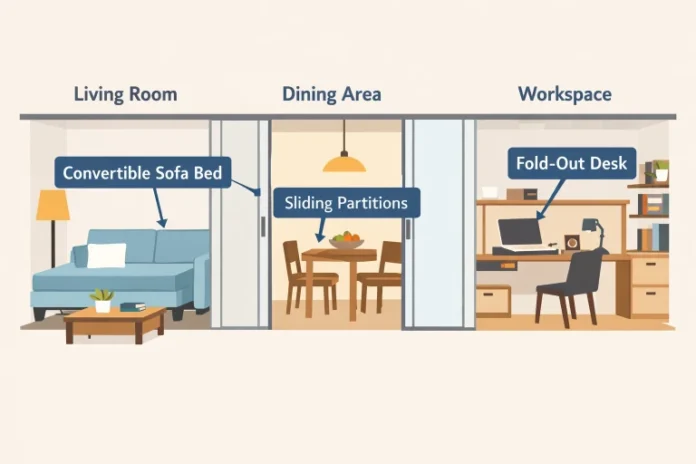
- Movable Partitions: Sliding doors, folding walls, or even curtains offer privacy when needed but can be opened up for a more spacious feel.
- Multi-Functional Furniture: Pieces such as wall beds, expandable tables, and storage ottomans allow rooms to quickly shift in purpose without sacrificing style or comfort.
Homeowners are also embracing modular elements, which enable entire sections of a home’s floor plan to be added, removed, or reorganized as family needs evolve. This approach supports personalization and sustainability, since the home can grow with the residents and reduce the need for future construction.
Real-Life Examples
The best testament to the impact of flexible floor plans comes from everyday homeowners. A couple starting may initially use a bonus room as a nursery. As children grow, that same room can transform into a homework nook or playroom, and later, as a guest bedroom when kids leave for college.
In urban apartments, flexible features like built-in Murphy beds and pocket doors enable even the smallest studio to comfortably accommodate guests, work-from-home setups, and entertainment, all in one compact space.
Families in ski resorts or mountain towns, for example, often look for homes where a mudroom can double as gear storage in winter and a craft area in warmer months. This versatility lets owners enjoy their spaces year-round and minimizes wasted space.
Future Trends
Looking ahead, the popularity of flexible floor plans is likely to grow. As homeowners become more intentional about how they use each area of their homes, builders and designers are responding with innovative solutions such as modular partitions, smart home systems, and convertible spaces.
Technologies such as voice-activated lighting, retractable walls, and furniture that morphs at the touch of a button are all paving the way for the ultra-flexible homes of tomorrow.
Notably, some experts now urge a careful balance between open and private spaces. According to a recent article, the drawbacks of completely open layouts, such as noise and clutter, have led to growing interest in “broken” or partially sectioned floor plans that retain both connectivity and privacy. This indicates the next chapter for residential design may blend openness with thoughtful zones tailored to everyday life.
Conclusion
Flexible floor plans represent a new era of residential design, offering homes that can adjust as families grow, lifestyles change, or needs evolve. Embracing adaptability, whether in newly built properties or through smart renovation, maximizes comfort and value. For today’s and tomorrow’s homeowners, flexible spaces create endless possibilities, ensuring that every home remains a perfect fit.

