


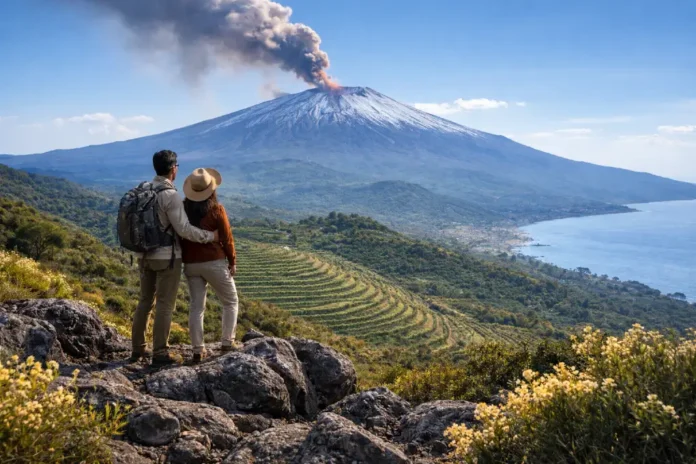
There are places that feel scenic the moment you see them, and then there are places that feel alive. Mongibello Etna belongs to the second kind. Rising over eastern Sicily with a shape that seems to change with the light, the weather, and its own restless volcanic activity, this mountain is far more than a postcard landmark. It is a force of nature, a cultural symbol, and a place where history, myth, agriculture, and daily life still meet in a very real way.
For many travelers, the first surprise is the name itself. Locals and writers have long referred to Mount Etna with names tied to different languages and eras. “Etna” is linked to the Greek idea of burning, while “Mongibello” reflects layers of linguistic history that speak to the island’s deep cultural mixing over centuries. That blend of names suits the mountain perfectly because this is not a place with just one identity. It is ancient and active, beautiful and intimidating, destructive and life-giving at the same time.
Mongibello Etna also carries serious geological importance. UNESCO describes Mount Etna as the most active stratovolcano in the world, with an eruptive history stretching back roughly 500,000 years and at least 2,700 years of documented human observation. That rare combination of scientific value and long cultural memory is one reason the site was inscribed on the World Heritage List in 2013.
What makes the mountain so compelling, though, is not only its size or scientific fame. It is the way it shapes the rhythm of the land around it. Villages live in its shadow. Vineyards climb its slopes. Forests, orchards, lava fields, and black-soil farms exist side by side. Visitors come for the drama of the volcano, but many leave remembering something quieter: the way Etna makes the entire landscape feel storied.
Why Mongibello Etna Feels Different From Other Famous Landmarks
Many great travel destinations impress from a distance. Mongibello Etna does that too, but its deeper appeal comes from contrast. One day it can look serene, with a broad silhouette above vineyards and stone villages. Another day, ash plumes or glowing summit activity remind everyone that this is an active volcano, not a frozen monument from the past. Britannica notes that Etna’s elevation changes over time because eruptions and crater collapses reshape the summit. In other words, the mountain visitors see today is never exactly the same mountain people saw a century ago.
That changing nature gives the place an emotional edge. You are not simply looking at history. You are standing inside a landscape that is still being made. Scientists continue to study Etna because its almost continuous eruptive activity offers an extraordinary record of volcanic processes. UNESCO specifically highlights its importance to volcanology, geophysics, and other Earth sciences.
At the same time, Mongibello Etna is not isolated from everyday life. This is one of the most fascinating things about it. Some volcanoes feel remote and untouchable. Etna feels woven into human routine. People farm around it, make wine from its soils, hike its trails, and build stories around its moods. That closeness between nature and community is a huge part of its charm.
The Meaning Behind the Name Mongibello Etna
The name “Etna” has classical roots. Britannica traces it to the Greek Aitne, from a word meaning “I burn,” which fits a mountain long associated with fire and eruption. “Mongibello,” meanwhile, reflects Sicily’s layered linguistic history and is widely understood as a hybrid name formed through successive cultural influences on the island. Even the name tells a story of Sicily as a crossroads of civilizations.
That matters because the mountain is not only a physical landmark. It is also a cultural text. Greek, Roman, Arab, Norman, and later Sicilian traditions all left traces on the island’s identity, and Etna sits at the center of much of that imagination. In myth and folklore, volcanoes are rarely neutral. They are often treated as sacred, dangerous, mysterious, or powerful. Etna has inspired exactly those feelings for centuries.
The result is that Mongibello Etna sounds less like a simple geographic label and more like a lived name, one that carries memory. It feels fitting for a mountain that has been observed, feared, studied, and admired for so long.
A Mountain With a Long and Documented Past
One reason Etna stands apart is the unusual depth of its documented history. UNESCO notes that while its eruptive history goes back around half a million years, human beings have recorded its activity for at least 2,700 years. INGV, Italy’s National Institute of Geophysics and Volcanology, has also highlighted more than 2,500 years of eruptive history through its recent databases and observatory work. Few active volcanoes have such an extensive record connecting ancient observation to modern science.
This long memory gives the mountain a rare historical texture. Etna is not just old in a geological sense. It is historically familiar. Generations have watched it, named its eruptions, mapped its flows, and adapted to its behavior. That accumulated experience helped turn the mountain into both a scientific case study and a cultural presence.
The 1669 eruption remains one of the most famous episodes in Etna’s story. INGV describes it as one of the most important events in the history of Italian volcanology over the last millennium. It is remembered not just because of its scale, but because it showed how deeply volcanic activity could affect settlements, agriculture, and the surrounding region.
When travelers visit today, they may come looking for scenery, but what they are really seeing is a landscape shaped by repeated cycles of destruction and renewal. That is part of what makes Etna emotionally powerful. Its history is visible in the land itself.
The Landscape Around Etna Is More Varied Than Most People Expect
People often imagine a volcano as a single cone surrounded by bare rock. Etna is more complex than that. Official tourism and park sources describe trails moving through woods, orchards, caves, steam vents, old lava fields, and high-altitude terrain with almost lunar views. The Etna Park area also includes remarkable ecological range, from cultivated lower slopes to higher forests where beech and birch survive in conditions unusual for Sicily.
That range is one reason the destination appeals to more than one kind of traveler. Adventure seekers can head for high-altitude routes and volcanic terrain. Nature lovers can focus on forests and protected habitats. Food and wine travelers can stay lower on the slopes, where the volcanic environment has supported agriculture for generations.
The contrast between black lava stone and green cultivation is especially striking. In many parts of Etna, the land looks almost divided between fire and fertility, but the truth is that the two are deeply linked. Volcanic activity can be destructive, yet over time it also contributes to the mineral-rich soils that have shaped farming traditions in the region. That tension is central to Etna’s identity.
How the Volcano Shapes Local Life
It is easy to romanticize Etna, but for local communities the mountain is not just scenery. It is an active presence. That means beauty comes with responsibility. Modern reporting on recent eruptions has shown how closely authorities monitor activity and how seriously safety warnings are taken when summit conditions change. Tourist access can be restricted, and local civil protection agencies regularly remind visitors that the volcano should be approached with respect, not casual overconfidence.
That practical side matters. The best way to appreciate Mongibello Etna is not to treat it like a theme park attraction. It is a living volcano with real risks. The mountain can be breathtaking and unpredictable in the same day. That is part of its power, but it also means travelers should follow official guidance, use qualified local operators when going higher, and pay attention to changing conditions.
For nearby communities, Etna is also tied to livelihood. Tourism, farming, hospitality, and wine production all depend in different ways on the mountain’s geography and reputation. In that sense, Etna does not sit outside daily life. It actively helps shape it.
Wine, Agriculture, and the Richness of Volcanic Soil
One of the most compelling parts of the Etna story is how a volcano associated with fire has also become a place of cultivation. On the lower slopes, park sources describe vineyards, hazelnut groves, orchards, and chestnut areas. This is not an accidental detail. Agriculture has long flourished where volcanic materials, climate variation, and elevation create distinctive growing conditions.
Etna’s wine culture is especially important. The Etna DOC production area is closely tied to the slopes of the volcano, and producers benefit from volcanic soils along with microclimates that vary from one side of the mountain to another. Writers and regional specialists repeatedly point to the effects of lava-derived soils, altitude, and temperature swings on grape character and wine style.
This connection between geology and taste gives Etna a broader appeal than many volcanic destinations. A visit here can include not only viewpoints and trails, but also vineyards, cellars, and meals shaped by the mountain’s environment. In practical terms, that makes Mongibello Etna an excellent destination for travelers who want a richer experience than simple sightseeing.
It also gives the mountain a different symbolic meaning. Etna is not only about eruption. It is also about transformation. Lava becomes soil. Harsh ground becomes cultivation. Risk becomes tradition. That cycle is one of the most beautiful things about the place.
What Travelers Usually Remember Most
Ask people what stays with them after visiting Etna, and the answer is often not a single crater or trail. It is the atmosphere. The mountain creates a sense of scale that changes how the whole region feels. Villages seem smaller, skies seem wider, and time feels layered. Ancient stories, geological ages, and present-day life all seem to exist at once.
The visual experience matters too. At lower elevations, you may pass vineyards, orchards, and villages built with dark volcanic stone. Higher up, the landscape becomes rougher, more open, and more dramatic. Tourism sources describe stretches of terrain that feel almost lunar, and that is not an exaggeration. The shift from cultivated land to raw volcanic scenery can happen surprisingly fast.
Then there is Valle del Bove, the vast basin on Etna’s eastern side, often singled out as one of the most memorable areas in the protected zone. It helps visitors grasp the mountain not just as a peak, but as a huge and complex volcanic system.
In simple terms, Etna feels bigger than a viewpoint. It feels like a world of its own.
A Good Visit Starts With the Right Expectations
The best Etna trips usually come from balanced expectations. This is not a destination where you should chase drama at all costs. It is better approached with patience and curiosity. Weather matters. Volcanic conditions matter. Access levels matter. A clear day may open wide views over the sea and the Sicilian landscape, while active conditions may shift what is possible.
That is one reason many travelers benefit from local guidance, especially for higher-altitude routes. Even when the mountain looks calm, summit access can involve technical or safety considerations that are easy to underestimate. Reuters reported during a recent eruptive phase that authorities urged tourists to heed warnings and avoid pushing beyond safe limits.
A more grounded mindset usually leads to a better experience anyway. Etna is rewarding even when you are not chasing the highest possible point. The forests, lava fields, villages, viewpoints, and food culture all add up to something memorable. You do not need a cinematic eruption to understand why the mountain matters.
Why Mongibello Etna Still Holds Such Strong Appeal
Some famous places fade once you understand them. Mongibello Etna does the opposite. The more you learn, the more layered it becomes. It is a volcanic landmark, a World Heritage site, a scientific archive, a cultural symbol, and a living environment that continues to shape the identity of eastern Sicily.
Its appeal also feels unusually balanced. Some travelers come for geology. Others come for scenery, hiking, mythology, photography, or wine. Very few major destinations combine all of those so naturally. That variety is part of why Etna continues to attract such wide interest.
Most of all, the mountain stays with people because it feels honest. It does not pretend to be safe, polished, or static. Its beauty is tied to motion and uncertainty. That makes it unforgettable.
In the end, Discover the Beauty and History Behind Mongibello Etna is more than a travel idea. It is an invitation to see how one place can hold fire, memory, risk, fertility, and wonder all at once. For anyone visiting Sicily, it is not just a landmark to check off. It is one of the clearest expressions of what makes the island so compelling: deep history, dramatic nature, and a way of life shaped by both.
If you want one final reference point after reading, the phrase Mount Etna offers a simple starting place, but the real meaning of the mountain only becomes clear when you see how fully it lives inside Sicily itself.
Conclusion
Mongibello Etna is beautiful in the obvious sense, but its real power comes from everything beneath that beauty. It is a mountain with ancient roots, a volcano with ongoing energy, and a place where people have learned to live with nature rather than simply look at it. That is why it continues to fascinate travelers, researchers, and locals alike.
To understand Mongibello Etna is to understand contrast: fire and soil, danger and attraction, destruction and renewal. That tension is exactly what makes it one of Sicily’s most remarkable places and one of Europe’s most memorable natural landmarks.

