


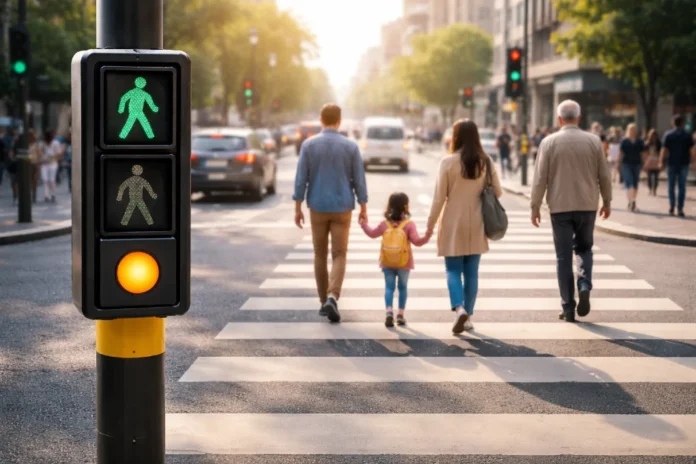
Modern cities depend on small systems that quietly make everyday life safer. One of those systems is the Pelican Crossing, a signal-controlled pedestrian crossing that helped reshape how people move through busy urban roads. It may seem like a routine part of traffic design, but its role in improving pedestrian safety was significant.
As streets became more crowded with vehicles, simple crossing points were no longer enough in many areas. Pedestrians needed something clearer, more reliable, and easier to trust. That is where this crossing system made a real difference. It introduced a more organized way for pedestrians and drivers to share the road, reducing confusion and making city streets feel more manageable.
What Is a Pelican Crossing?
A Pelican Crossing is a pedestrian light-controlled crossing designed to stop traffic so people can cross more safely. The term comes from “PEdestrian LIght CONtrolled,” which was shortened into the familiar name. In practical terms, it uses traffic lights, pedestrian signals, and push-button controls to create a safer crossing opportunity on roads with regular traffic flow.
What made this design stand out was its signal sequence. Pedestrians wait for the green figure before crossing, while drivers stop at the red light. Near the end of the crossing phase, the pedestrian signal begins to flash, and drivers then see a flashing amber light, meaning they may move only when the crossing is completely clear.
This approach created a structured exchange between people walking and people driving. Instead of relying only on judgment and timing, both sides were given a clear set of signals to follow.
Why This Crossing System Mattered
Road safety is often improved through simple changes that reduce uncertainty. This crossing type did exactly that. In growing towns and cities, vehicle traffic was increasing, and crossing a road safely was becoming more difficult, especially for children, older adults, and people with mobility challenges.
A controlled crossing gave pedestrians more confidence. It also placed a legal and visual obligation on drivers to stop and yield at the right moment. That predictable structure helped reduce hesitation and made the road environment easier to understand.
Its importance was not just technical. It changed expectations. Once people became used to this kind of controlled crossing, they began to expect more organized and pedestrian-friendly road design in busy areas.
How It Changed Urban Safety
The biggest contribution of this system was clarity. Streets are safer when everyone understands what happens next. When pedestrians know when to cross and drivers know when to stop, conflict is reduced.
Before signal-controlled pedestrian crossings became common, many people had to depend heavily on gaps in traffic or driver courtesy. That could work on quieter roads, but it was less reliable in dense urban settings. A formal crossing system improved that experience by replacing guesswork with clear timing and visible signals.
This also supported a wider change in city planning. Streets were no longer seen only as spaces for moving cars. They were also places where people walked to school, shops, transport stops, and workplaces. Safe crossings became part of making cities more livable.
How It Works in Everyday Traffic
For pedestrians, the process is simple. A person arrives at the crossing, presses the button, waits for the signal, and crosses when the green figure appears. This removes much of the stress that comes with judging fast-moving traffic.
For drivers, the rules are equally important. They must stop at red and stay alert even when the amber light begins flashing. If someone is still on the crossing, the vehicle must continue to wait. The design is careful and practical because it allows traffic to move again once the crossing is clear, without taking away pedestrian protection.
This balance between safety and flow is one reason the system became so influential. It did not simply stop traffic for long periods. It managed movement in a way that was easier for both sides to understand.
Why It Worked So Well
Several design choices helped make this crossing type effective. The first was visibility. The signals were obvious, the crossing area was clearly marked, and both pedestrians and drivers could quickly see what was expected.
The second was consistency. Good traffic systems work best when the rules are familiar. Once road users learned the signal pattern, they could respond more confidently.
The third was accessibility. A well-designed crossing is not only for healthy adults moving at a quick pace. It should also work for children, older people, wheelchair users, and blind or partially sighted pedestrians. Features such as tactile paving, dropped curbs, audible signals, and tactile cones helped improve usability for a wider group of people.
A Step Forward From Older Crossings
To understand the impact of this system, it helps to compare it with older road crossings. A zebra crossing relies on markings and driver awareness, without traffic lights controlling the movement. That can be effective on slower roads, but it offers less structure where vehicle flow is heavier.
Signal-controlled crossings provided more certainty. They made it easier to handle busy roads where constant traffic made informal crossing harder. In that sense, this design marked an important stage in the development of safer urban streets.
It showed that pedestrian safety could be built into traffic management rather than treated as a secondary concern. That idea helped shape later road design decisions in many places.
The Shift to Newer Crossing Designs
Over time, transport planners introduced newer types of pedestrian crossings. These designs often used updated signal placement, sensors, and more responsive timing systems. As a result, some areas moved away from older installations and adopted more modern alternatives.
Even so, that does not reduce the historical value of this crossing type. It played a major role in the transition from simpler pedestrian crossings to smarter and more adaptive urban traffic systems.
Many existing installations remained in use for years, and the principles behind them still influence modern road design. Clear signals, visible priority, and predictable timing are all ideas that continue to matter today.
Common Misunderstandings
Despite its strengths, this crossing system has sometimes caused confusion. Some road users are unsure about the flashing signals, especially the moment when vehicles see flashing amber. That phase does not mean drivers can rush forward. It means they may proceed only if the crossing is fully clear.
This matters because a crossing is only as safe as the behavior around it. If users misunderstand the signals, the value of the design can be weakened. That is why road safety education remains important even when the infrastructure itself is well designed.
Still, confusion is not unusual in traffic systems. Many road features depend on people remembering rules they may not use every day. The answer is not to dismiss the crossing, but to improve awareness and keep signals as intuitive as possible.
What It Teaches About Safer Streets
One of the biggest lessons from this system is that safety improves when design reduces guesswork. Urban roads are full of quick decisions, and every moment of uncertainty can raise the risk of mistakes.
A safer crossing is not just about stopping cars. It is about making the crossing process obvious, visible, and fair. That helps pedestrians feel more secure and helps drivers respond with more confidence.
It also shows why walking infrastructure matters. Cities often focus heavily on traffic flow, yet the quality of pedestrian crossings shapes whether an area feels accessible, welcoming, and practical for daily life. If crossing the road feels stressful, the street does not truly serve the people using it.
Why It Still Matters Today
Even where newer systems are preferred, this crossing model still matters because of what it introduced into mainstream road design. It helped normalize the idea that pedestrians need dedicated protection in busy traffic environments.
Its influence can still be seen in modern planning. Today’s crossings may use updated technology, but the core principle remains the same: road users are safer when the rules are visible and the interaction is controlled.
That legacy is important. A city becomes more humane when walking is treated as a normal and protected part of movement, not as something people must manage on their own in hostile traffic conditions.
Real-World Value for Drivers and Pedestrians
For pedestrians, the practical value is confidence. A controlled crossing makes it easier to move through a busy street without relying entirely on finding a gap in traffic.
For drivers, the benefit is structure. A clearly signaled crossing reduces uncertainty and creates a more organized flow. Instead of sudden braking or informal yielding, the interaction is controlled by signals everyone can see.
This kind of design may appear ordinary now, but that is often the mark of successful infrastructure. Once a safety feature becomes familiar, people forget how much disorder existed before it.
Conclusion
The Pelican Crossing changed urban safety because it turned a difficult road-crossing moment into a more controlled and predictable interaction. It helped cities respond to growing traffic pressures while giving pedestrians a stronger sense of protection and priority.
Its lasting importance lies in what it proved. Streets work better when safety is built into the design, not left to chance. Even though newer crossing systems now exist, the ideas behind the Pelican Crossing still shape how safer urban roads are planned and understood. In the wider history of pedestrian crossings, it remains an important step toward better streets for everyone.

