


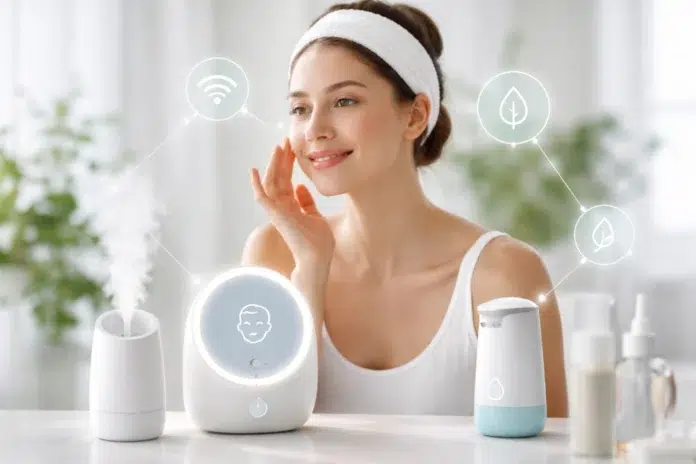
There is something appealing about a skincare routine that feels calm, easy, and consistent instead of rushed and half-finished. That is exactly where Smart Home Devices Skincare Tips become useful. The right devices do not replace good skincare habits, but they can make those habits easier to follow by improving lighting, timing, air quality, comfort, and sleep, all of which affect how your skin looks and feels over time.
A lot of people think skincare begins and ends with cleanser, moisturizer, and sunscreen. That basic foundation still matters most, and dermatologists continue to recommend gentle cleansing, moisturizing, and daily sun protection as the core of everyday skin care. What smart home technology can do is support the environment around that routine so it becomes easier to stick with it in real life.
If you have ever applied products in poor bathroom lighting, forgotten to turn on a humidifier during dry weather, stayed up too late under bright lights, or rushed through your nighttime routine because your room did not feel relaxing, then you already know the problem is not always the products. Sometimes the setup around your routine is what needs help. That is where smart mirrors, tunable lights, humidifiers, air purifiers, smart speakers, sleep-friendly lighting, and automation can quietly improve your results.
This article takes a practical look at how to use technology at home in a way that supports healthier skin without turning your bathroom into a gadget showroom. The goal is not to buy everything. The goal is to build a smarter environment for better habits.
Why Smart Home Devices Matter for Skincare
Most skincare routines fail for very ordinary reasons. People forget steps, skip nighttime care, use the wrong lighting when checking their skin, or sleep poorly and wonder why their face looks tired in the morning. Smart home devices help solve those small daily problems.
Good skincare is heavily tied to consistency. A gentle cleanser, moisturizer, and sunscreen work best when used regularly, not occasionally. Dermatology guidance emphasizes those basics, and smart routines can help you remember and maintain them with less effort.
Your home environment also matters more than many people realize. Indoor humidity that is too low can leave skin feeling tight and uncomfortable, while lighting and screen-heavy nighttime routines can affect sleep, and sleep quality has obvious effects on how refreshed skin looks the next day. The U.S. Environmental Protection Agency recommends keeping indoor humidity between 30% and 50%, and sleep experts note that light strongly influences circadian rhythm and melatonin production.
So when people talk about beauty tech, the conversation should not just be about fancy tools touching your face. It should also include the room, the air, the schedule, and the habits that shape your skin every day.
The Best Smart Home Setup for a Realistic Skincare Routine
A useful skincare setup at home does not need to be expensive. It needs to remove friction and make your daily habits easier to follow. That is where Smart Home Devices Skincare Tips become especially practical, because the right setup can support consistency without making your routine feel complicated.
The best smart environment usually includes a few simple categories. Instead of filling your space with unnecessary gadgets, focus on devices that improve lighting, comfort, air quality, and routine reminders so your skincare feels more natural and easier to maintain.
1. Smart lighting for better product application
Lighting changes everything. Harsh overhead light can make skin look uneven in ways that are not accurate, while dim yellow lighting can make it hard to see what you are doing. Smart bulbs and smart mirrors let you control brightness and color temperature so you can check your skin more clearly.
For morning skincare, brighter neutral light helps you apply sunscreen evenly and see whether products are blending properly. At night, warmer light feels calmer and may support better sleep habits because evening light exposure affects circadian rhythm.
A practical tip is to set up two lighting scenes:
- Morning mode: bright, neutral white light
- Night mode: warm, dim lighting for a calmer routine
That one change alone can make your skincare routine feel more intentional and less chaotic.
2. Smart humidifiers for dry or tight skin
If your skin feels dry after cleansing even when you use moisturizer, your room air may be part of the problem. Smart humidifiers are useful because they can monitor and maintain a target humidity range rather than running nonstop.
The ideal indoor humidity range of 30% to 50% is a helpful benchmark for comfort and air quality. In practical terms, that range can help prevent the overly dry indoor conditions that often make skin feel rough, flaky, or irritated.
A smart humidifier is especially helpful if you:
- sleep with air conditioning on
- live in a dry climate
- notice more flaking in winter
- use actives like retinoids or exfoliants that can increase dryness
Place it in the bedroom rather than right next to your face. The goal is to improve the room environment, not create damp air directly on the skin.
3. Air purifiers for a cleaner bedroom environment
While skincare products work on the skin itself, the air around you can still affect comfort. Dust, smoke, and indoor pollutants can make a room feel stale and unpleasant. A smart air purifier can help you keep bedroom and vanity areas cleaner and track when the air quality changes.
This is particularly useful for people who live in traffic-heavy areas, cook often in open spaces, or deal with seasonal indoor irritation. Even if you are not treating a medical skin issue, cleaner air can make your self-care space feel fresher and more comfortable, which increases the odds that you stick to your routine.
4. Smart speakers and reminders for consistency
A skincare routine sounds simple until life gets busy. That is why reminders matter. A smart speaker or voice assistant can help you build repeatable habits without making them feel forced.
You can set reminders like these:
- Wash face at 9:30 p.m.
- Refill humidifier every evening
- Replace pillowcase twice a week
- Apply sunscreen before leaving home
- Turn vanity lighting to morning mode at 7:00 a.m.
These tiny prompts may sound basic, but consistency is often what separates a random routine from one that actually helps.
5. Smart plugs for small beauty tools
Some people use facial steamers, towel warmers, or bedside diffusers as part of a self-care routine. Smart plugs let you control those devices with schedules or voice commands. This can be useful, but it is best to stay selective.
A smart plug makes sense when it supports comfort and routine. It does not make sense when it encourages overuse of heat or unnecessary devices on the skin. In skincare, simpler is often safer.
Smart Home Devices Skincare Tips for Morning Routines
Morning skincare should feel clean and efficient, not overly complicated. Most people do best with a routine that includes cleansing if needed, moisturizing, and broad-spectrum sunscreen. The American Academy of Dermatology recommends sunscreen with SPF 30 or higher as part of morning protection.
Here is where smart devices help in the morning.
Use bright vanity lighting
Natural-looking smart light helps you see whether sunscreen is fully blended around the nose, hairline, jawline, and neck. Those are the places people often miss.
Pair your routine with a weather or UV check
A voice assistant can give you the weather and UV conditions while you get ready. That makes sunscreen feel like part of the morning plan instead of an afterthought.
Automate the room temperature
If your bathroom or bedroom is uncomfortably cold, routines get skipped. A smart thermostat can make early mornings more comfortable, which sounds small but often improves adherence.
Keep the air balanced
If your skin feels dehydrated in the morning, especially after using overnight treatments, a bedroom humidifier can help support a less drying environment overnight. The room setup matters almost as much as the products in some seasons.
Smart Home Devices Skincare Tips for Night Routines
Nighttime is where smart home support really shines. Many people know what they should do at night but lose motivation when they are tired.
A smarter setup can make the evening routine feel easier.
Shift to warm light in the evening
Bright cool-toned lighting at night can feel stimulating. Sleep experts note that light exposure in the evening can delay your body clock, while warmer dimmer conditions are more sleep-friendly.
That matters for skin because poor sleep tends to show up quickly. Skin may look duller, puffier, or more tired when your rest is inconsistent. So a warm lighting schedule is not just a mood feature. It supports the routine around recovery.
Set a skincare reminder before bedtime, not at bedtime
This is one of the most useful habit tricks. If your routine reminder comes when you are already exhausted, you are more likely to skip it. Set it 30 to 45 minutes earlier.
That way, cleansing and moisturizing happen while you still have energy.
Create a low-stimulation bedroom environment
A good nighttime setup often includes:
| Device | How it helps |
|---|---|
| Smart bulb | switches to warm, dim light |
| Smart speaker | plays calming audio or routine reminder |
| Smart humidifier | keeps room from getting too dry |
| Smart air purifier | freshens bedroom air |
| Smart plug | turns off bright vanity devices after use |
This kind of setup makes self-care feel easier without overcomplicating it.
Which Devices Actually Improve Skin, and Which Just Add Hype?
This is the question people should ask more often.
Not every beauty device deserves a place in your routine. In fact, many of the most useful tools are not direct skincare tools at all. They are environmental helpers.
The devices that usually offer the most practical value are:
- smart lighting
- humidifiers
- air purifiers
- smart reminders
- sleep-supportive automation
The devices that need more caution are facial gadgets that promise dramatic changes without much evidence or that encourage frequent heat, pulling, or irritation. If a device makes your skin red, overly sensitive, or dependent on constant use, it is probably not improving your routine.
There is also growing research interest in blue light and skin. Reviews indexed on PubMed note that visible blue light exposure may contribute to hyperpigmentation and photoaging under certain conditions, though the evidence is still developing and real-world exposure varies. That means screen-heavy habits are worth thinking about, but they are not a reason to panic. A more balanced takeaway is to reduce unnecessary nighttime screen exposure, protect your skin with a well-rounded routine, and avoid treating every trend like a crisis.
Building a Smart Skincare Space Without Overspending
You do not need a full home automation system to make skincare easier. A simple setup can still be effective.
Start with the problems you actually have.
If your skin gets dry every winter, a smart humidifier is a better buy than another trendy serum. If you rush through sunscreen because your bathroom lighting is terrible, smart bulbs may help more than a new mirror. If you skip your night routine because you are always tired, reminder automation and warmer evening lighting may matter most.
A smart skincare space should solve a real friction point. That is the rule.
Here is a realistic order of priority for most homes:
- Smart lighting
- Smart reminders or voice assistant
- Smart humidifier
- Smart air purifier
- Optional smart plugs for comfort items
This order keeps the focus on daily use rather than novelty.
Common Mistakes People Make With Tech and Skincare
Technology can help, but it can also distract from basics. These are the mistakes that show up most often.
Buying devices before fixing the basics
No smart mirror can replace daily sunscreen. No humidifier replaces moisturizer. No voice assistant replaces washing your face at night. Dermatology basics still come first.
Using harsh light to judge your skin
Some people become obsessed with every tiny pore or texture detail under extremely bright magnifying mirrors. That can lead to unnecessary picking and over-treatment. Good lighting should help you apply products well, not encourage skin anxiety.
Letting devices make routines too complicated
If your skincare setup has six apps, four timers, and constant alerts, it will stop feeling supportive and start feeling exhausting. Choose the smallest amount of tech that makes the biggest difference.
Ignoring sleep as part of skincare
This is a big one. People spend heavily on products but keep bright screens and alert lighting on until late at night. Sleep and light habits matter more than many people think.
A Simple Example of a Smart Home Skincare Routine
Here is what a balanced day can look like.
At 7:00 a.m., bedroom lights switch gradually to a brighter neutral tone. A voice assistant gives the weather and reminds you to apply sunscreen. In the bathroom, clear lighting makes it easier to cleanse lightly, moisturize, and apply sunscreen evenly before leaving home.
In the evening, lights begin warming around 8:30 p.m. A reminder goes off at 9:15 p.m. so you do your skincare before you feel too tired. The bedroom humidifier maintains comfortable moisture through the night, while the air purifier runs quietly in the background. Nothing feels extreme, but the routine becomes easier to repeat.
That is what effective beauty tech looks like in real life. It supports you quietly.
Frequently Asked Questions
Are smart home devices necessary for better skin?
No. A simple routine with cleanser, moisturizer, and sunscreen is still the foundation. Smart home devices are helpful because they make good habits easier to maintain.
What is the best smart device for skincare beginners?
Smart lighting is usually the best first choice because it helps with product application, routine timing, and nighttime relaxation.
Can a humidifier really help skin feel better?
It can help improve the indoor environment, especially if your room air is very dry. The EPA recommends indoor humidity between 30% and 50%, which is a useful range for home comfort.
Do screens affect skin?
Research suggests blue light may have effects related to pigmentation and photoaging in some contexts, but the evidence is still evolving. It is reasonable to reduce unnecessary nighttime screen exposure and focus on good skincare basics instead of overreacting to the trend.
Conclusion
The best Smart Home Devices Skincare Tips are not about turning your routine into a tech performance. They are about making skincare feel simpler, calmer, and easier to repeat. When your lighting is better, your room air is more comfortable, your reminders are timed well, and your evenings feel less overstimulating, your routine becomes something you can actually maintain.
That is the real advantage of smart home support. It helps the environment around your skincare work in your favor. If you think of your routine as part of a wider wellness setup rather than just a few bottles on a shelf, you start making better choices. Even small upgrades can make daily care feel smoother and more consistent.
In the end, better skin usually comes from better habits, not louder products. A thoughtful setup built around comfort, timing, and simplicity can make a noticeable difference over time. That is the quiet power of a well-designed home automation routine when it is used with common sense.

