


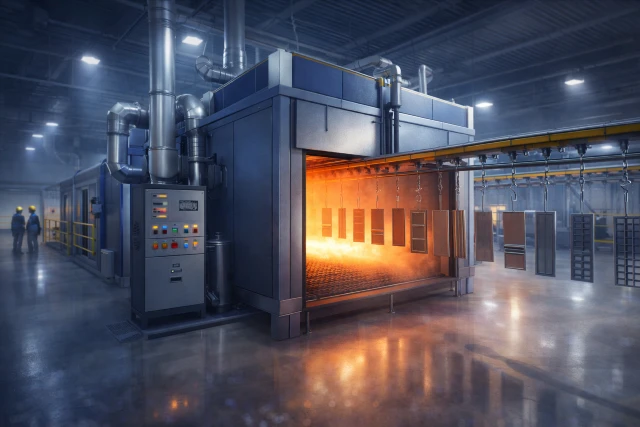
Finishing failures often trace back to heat delivery rather than material choice. Many coating lines appear to hit temperature targets, yet still release parts with weak adhesion or soft films. Undercuring shows up more frequently than overcuring because heat reaching the part rarely behaves the way operators expect inside an industrial powder coating oven.
How Uneven Airflow Creates Cold Spots in the Oven?
Airflow is the silent driver of heat transfer inside powder coating ovens. Even when the oven air temperature reads correctly, poor circulation can leave pockets of stagnant air around parts. These cold zones prevent powder from reaching the full cure temperature needed for proper crosslinking.
What complicates the issue is that airflow problems are not always visible. Fans may be running, ducts may appear clear, yet distribution remains uneven. High-quality powder coating systems are designed with balanced airflow paths that move heated air consistently across every surface, reducing the chance of localized undercure.
Why Can Conveyor Speed Shorten Cure Time Too Much?
Conveyor speed directly controls how long a part stays exposed to curing temperatures. Small speed increases may seem harmless, but they quickly shave critical minutes off dwell time. Powder coatings rely on both temperature and time to fully cure, and losing either leads to incomplete bonding.
In many operations, speed adjustments happen to meet production demands without recalculating cure profiles. An industrial powder coating oven built with precise control zones allows operators to compensate for speed changes more effectively. Without that flexibility, undercuring becomes a frequent outcome.
What Happens When Part Mass Slows Heat Absorption?
Heavier or thicker parts absorb heat more slowly than thin components. While oven air may reach the set temperature quickly, dense metal takes longer to warm through its core. If the part exists before internal temperature stabilizes, the powder never fully reacts.
This mismatch often goes unnoticed because surface temperature rises faster than internal temperature. Powder coating equipment packages designed for mixed loads account for mass variation by providing longer heat zones or higher energy delivery, reducing undercuring risk across different part sizes.
The Role of Thermostat Placement in True Part Heat
Thermostats measure air temperature, not part temperature. If sensors are placed too close to heat sources or exhaust points, readings can misrepresent actual conditions where parts travel. This leads operators to believe cure requirements are met when parts are still below the target temperature.
Proper oven design places sensors where airflow and load interaction best reflect real conditions. Advanced powder coating ovens integrate multiple sensing points to provide a clearer picture of internal performance. This design approach helps close the gap between air heat and part heat.
Why Insufficient Preheating Leads to Incomplete Cure?
Preheating plays a larger role in curing than many expect. Parts entering the cure zone too cold require extra energy just to reach reaction temperature. If the oven is sized tightly, that extra demand shortens the effective cure window.
Cold starts, frequent door openings, or inconsistent line loading all affect preheat performance. High-quality powder coating equipment maintains stable thermal conditions from entry to exit. Consistent preheating ensures powder chemistry activates as designed rather than struggling to catch up.
How Thick Powder Layers Resist Full Chemical Bonding?
Thicker powder applications look appealing for durability but introduce curing challenges. Heat must penetrate the entire coating layer to trigger complete chemical bonding. If the outer layer cures first, it can insulate the inner layer and trap uncured material beneath.
This issue becomes more pronounced in ovens with limited heat uniformity. Industrial powder coating ovens built for precision deliver consistent energy that penetrates thicker films more effectively. Without that capability, undercure hides beneath what appears to be a finished surface.
Why Poor Oven Insulation Lets Heat Slip Away?
Insulation quality determines how well an oven holds and distributes heat. Thin or degraded insulation allows heat to escape, forcing burners or heaters to work harder while internal temperatures fluctuate. These fluctuations reduce the time parts spend at the proper cure temperature.
Energy loss also affects recovery time after door openings or load changes. Powder coating equipment for sale varies widely in insulation performance. Systems designed with robust insulation maintain steady internal environments that support complete curing across every cycle.
How Load Patterns Change How Heat Reaches Parts?
How parts are arranged on the conveyor influences airflow and heat exposure. Tightly packed loads block air movement, while uneven spacing creates shadows where heat struggles to reach. These patterns cause inconsistent curing even within the same batch.
Experienced operators adjust racking, but oven design still matters. Powder coating systems engineered for complex loads distribute air vertically and horizontally to minimize blockage effects. This design flexibility helps prevent undercure caused by poor heat access.
What Makes Undercure More Common than Overcure?
Overcuring requires excessive heat or extended dwell time, which most systems avoid through safeguards. Undercuring, however, happens quietly when any part of the heat transfer chain falls short. Small inefficiencies compound into an incomplete cure without obvious warning signs.
From airflow balance to insulation quality, every design detail influences cure reliability. Investing in a well-engineered industrial powder coating oven reduces hidden variables that cause undercure. Strong oven design favors consistent success rather than narrow operating margins.
Reliant Finishing Systems provides industrial ovens known for their durability and consistent performance. Their ovens are engineered with quality insulation, precise heat control, and robust airflow systems that help achieve reliable results cycle after cycle. Built for real production environments, these industrial ovens support long-term use with dependable operation and minimal downtime.

