


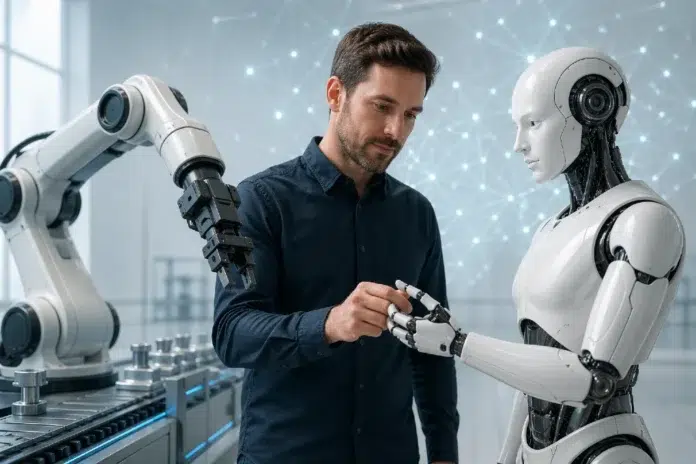
Ponas Robotas may sound like a mysterious phrase at first, but it fits perfectly into today’s conversation about artificial intelligence, automation, robotics, and the way machines are becoming part of daily life. Whether people connect the phrase with smart robots, digital systems, or the wider idea of human-machine interaction, Ponas Robotas gives us a useful starting point for understanding where modern technology is heading.
We no longer live in a world where robots only belong in science fiction. They clean homes, move products inside warehouses, assist surgeons, inspect factories, answer customer questions, and help businesses make faster decisions. Some are physical machines with arms, wheels, cameras, and sensors. Others are software-based systems that automate work behind the scenes.
That is why Ponas Robotas feels relevant now. It represents more than a robot. It points to a bigger shift: machines are becoming smarter, more connected, and more capable of working beside people.
What Does Ponas Robotas Mean in a Technology Context?
In a modern technology context, Ponas Robotas can be understood as a phrase linked to intelligent robots, AI-powered systems, and automation tools that support human tasks. It brings together ideas from robotics, artificial intelligence, cybersecurity, smart devices, and digital transformation.
The phrase has also appeared online in discussions that connect it with robotics, AI, ethics, and even the techno-thriller world of “Mr. Robot.” Public references describe “Ponas Robotas” as a concept tied to smart robotics and human oversight, while Wikipedia identifies “Mr. Robot” as an American psychological techno-thriller centered on a cybersecurity engineer and hacker.
For a blog reader, the important point is simple. Ponas Robotas is a useful keyword for discussing how robots are no longer just machines that repeat commands. Today’s advanced systems can sense, learn, adjust, and respond.
That change is what makes the topic worth exploring.
Why Ponas Robotas Matters in Modern Technology
Ponas Robotas matters because robotics and AI are moving from factories into everyday life. A few years ago, many people thought of robots as large industrial machines locked behind safety fences. That picture is outdated.
Today, robots and automation systems appear in:
- Smart homes
- Hospitals
- Warehouses
- Farms
- Schools
- Retail stores
- Customer service platforms
- Delivery and logistics
- Manufacturing plants
- Security and inspection work
The International Federation of Robotics reported that 542,000 industrial robots were installed worldwide in 2024, more than double the number from ten years earlier. Annual installations also stayed above 500,000 units for the fourth year in a row, showing that robotics is no longer a small or experimental field.
That growth explains why Ponas Robotas has strong search intent. People want to understand what smart robots are, how automation works, and whether these technologies will help or harm human life.
The answer is not one-sided. Robotics can make work safer, faster, and more accurate. But it also raises serious questions about privacy, job changes, data control, and machine decision-making.
Ponas Robotas and Artificial Intelligence
Artificial intelligence is the brain behind many modern robotic systems. Without AI, a robot may only follow fixed instructions. With AI, it can process data, recognize patterns, make predictions, and adapt to changing situations.
Think about a warehouse robot. An older machine might move along a fixed track. A smarter AI-powered robot can scan its surroundings, avoid obstacles, choose a better route, and keep working even when the environment changes.
That is where Ponas Robotas becomes more interesting. It is not just about metal arms or moving machines. It is about robots that can interact with the real world in a more flexible way.
AI helps robots perform tasks such as:
- Object recognition
- Voice response
- Route planning
- Quality inspection
- Predictive maintenance
- Human gesture detection
- Automated decision support
- Natural language communication
In business, AI is also becoming part of daily operations. McKinsey’s 2025 State of AI report noted that companies are moving beyond experiments and focusing more on workflow redesign, leadership ownership, governance, and scaling AI for real value.
This matters because Ponas Robotas is not only a futuristic idea. It connects directly with how companies are already changing the way they work.
The Role of Automation in Ponas Robotas
Automation means using technology to complete tasks with little or no direct human involvement. It can be simple, like an email reminder that sends automatically. It can also be complex, like a factory line where robots assemble products, check quality, and report problems.
Ponas Robotas fits naturally into automation because smart robots are often built to reduce repetitive work. They do not get tired in the same way humans do. They can repeat precise movements thousands of times. They can also work in environments that may be unsafe for people.
In real life, automation appears in many forms.
A small online store may use automated inventory alerts. A hospital may use robotic systems to move supplies. A factory may use robotic arms to weld, lift, paint, or package products. A smart home may use sensors and AI to adjust lighting, temperature, and security.
The key benefit is not only speed. Good automation reduces errors, improves consistency, and frees people to focus on higher-value tasks.
Still, automation should not be treated as magic. Poorly designed automation can frustrate users, create security risks, and make simple problems harder to solve. The best systems are built around real human needs.
That is one of the biggest lessons behind Ponas Robotas: technology should serve people, not confuse or control them.
Ponas Robotas in Robotics: From Machines to Smart Partners
Robotics is the field that brings mechanical design, electronics, software, sensors, and AI together. A robot must be able to do something in the physical world. It may move, lift, sort, clean, inspect, assist, or interact.
The older idea of a robot was simple: a machine that follows commands. The modern idea is more advanced. Robots are becoming smart partners that can work near humans and respond to changing conditions.
For example, collaborative robots, often called cobots, are designed to work closer to people than traditional industrial robots. They can help with assembly, packaging, inspection, and material handling. They are often smaller and easier to program than older factory robots.
Safety is a major part of this progress. ISO 10218-1:2025 and ISO 10218-2:2025 provide safety requirements for industrial robots and robotic applications, including areas such as integration, commissioning, operation, maintenance, and repair.
That shows why Ponas Robotas should not be discussed only as a cool technology trend. Robotics must be practical, safe, and responsible.
A smart robot that saves time is useful. A smart robot that saves time while protecting workers, data, and customers is far more valuable.
How Ponas Robotas Is Used in Everyday Life
Many people think robotics is far away from their normal routine. In reality, smart automation is already around them.
A robot vacuum maps rooms and avoids furniture. A smart assistant responds to voice commands. A fitness app studies movement and recommends activity. A delivery system tracks packages through automated sorting centers. A bank uses automated fraud detection to flag suspicious activity.
Not all of these are physical robots, but they belong to the same larger world of intelligent automation. Ponas Robotas works as a broad idea because it covers both visible machines and invisible digital systems.
Here are some simple examples.
Smart Homes
In homes, automation can control lights, security cameras, thermostats, speakers, cleaning devices, and appliances. The goal is convenience, but the real value comes when devices work together smoothly.
A smart home built around Ponas Robotas thinking would not just add gadgets for the sake of it. It would use automation to solve real problems, such as saving energy, improving safety, and helping older adults live more independently.
Healthcare
In healthcare, robotics can support surgery, rehabilitation, medication delivery, patient monitoring, and hospital logistics. Robots do not replace doctors or nurses, but they can support them.
A surgical robot, for example, can help a trained surgeon perform delicate procedures with more precision. A rehabilitation robot can guide patients through repeated movement exercises. An automated hospital cart can move supplies so staff can spend more time with patients.
This is where Ponas Robotas becomes meaningful. The best technology does not remove human care. It gives people better tools.
Business and Offices
In offices, automation often happens through software rather than physical robots. AI tools can summarize documents, schedule meetings, analyze customer behavior, organize data, and support customer service.
For a small business owner, Ponas Robotas could mean using automation to reduce repetitive admin work. For a larger company, it could mean redesigning entire workflows around AI-assisted decision-making.
The smart approach is to begin with one clear pain point. A company should not automate everything at once. It should identify tasks that are repetitive, measurable, and time-consuming, then test automation carefully.
Manufacturing and Warehousing
Factories and warehouses are among the strongest areas for robotics. Robots can lift heavy items, move goods, inspect products, and complete repetitive assembly steps.
This is not just about replacing workers. In many cases, robots handle dull, dirty, or dangerous tasks while humans manage planning, maintenance, quality control, and problem-solving.
Ponas Robotas in this setting means a workplace where people and machines share responsibilities more intelligently.
Ponas Robotas and Cybersecurity
Any connected robot or smart device can become a security risk if it is not protected. This is one of the most important parts of the topic, especially when robotics connects with AI, cloud systems, cameras, microphones, and personal data.
A robot may collect information about a home, workplace, customer, patient, or factory process. If that data is stolen or misused, the damage can be serious.
Cybersecurity matters because smart robots often depend on:
- Wi-Fi or network access
- Cloud processing
- User accounts
- Cameras and sensors
- Software updates
- Remote control features
- Data storage systems
Ponas Robotas should always include a security-first mindset. A smart machine is only truly smart if it is protected from misuse.
For everyday users, that means using strong passwords, updating device software, avoiding unknown apps, and checking privacy settings. For businesses, it means access control, employee training, network monitoring, vendor review, and clear rules for data use.
The more intelligent machines become, the more important digital trust becomes.
Human Oversight: The Most Important Part of Ponas Robotas
Human oversight means people remain responsible for how AI and robots are designed, used, checked, and improved. This is especially important when machines influence health, safety, money, employment, education, or legal decisions.
The National Institute of Standards and Technology describes trustworthy AI as systems that are valid and reliable, safe, secure, resilient, accountable, transparent, explainable, privacy-enhanced, and fair with harmful bias managed.
That list matters because Ponas Robotas should not be treated as technology without responsibility. A robot may be powerful, but power without oversight can cause harm.
For example, if an AI system is trained on biased data, it may make unfair recommendations. If a delivery robot fails to detect a child or pet, it may create safety risks. If a smart camera stores private footage without clear controls, it may damage trust.
Human oversight does not mean stopping innovation. It means guiding innovation in a way that protects people.
Good oversight includes:
- Clear responsibility for decisions
- Human review for high-risk outcomes
- Transparent privacy policies
- Regular safety testing
- Bias checks in AI models
- Easy ways for users to report problems
- Simple controls for turning automation off
In short, Ponas Robotas should be intelligent, but it should also be accountable.
Benefits of Ponas Robotas for People and Businesses
The biggest benefit of Ponas Robotas is not that machines can do more. The real benefit is that people can spend less time on repetitive work and more time on creative, strategic, and human-centered tasks.
For individuals, smart robotics can make life easier. A robot vacuum saves time. A smart home system can improve comfort. A wearable health device can encourage better habits. Assistive robots may help people with limited mobility.
For businesses, robotics and AI can improve productivity, quality, and speed. A factory robot can reduce waste by performing precise movements. A customer service chatbot can answer simple questions quickly. An AI system can detect patterns in data faster than a human team could do manually.
The practical benefits include:
- Faster task completion
- Lower error rates
- Better safety in risky environments
- More consistent product quality
- Reduced manual workload
- Improved customer support
- Better use of data
- Stronger operational efficiency
But these benefits only happen when the technology is planned well. Buying a robot or AI tool without a clear purpose often leads to wasted money.
A smart Ponas Robotas strategy begins with a question: what real problem should this technology solve?
Challenges and Risks Around Ponas Robotas
Every technology trend comes with challenges. Ponas Robotas is no different.
The first challenge is cost. Advanced robots can be expensive to buy, install, maintain, and train employees to use. Even software automation can require planning, integration, and security work.
The second challenge is trust. People may feel uncomfortable when machines make decisions or collect data. This is especially true in healthcare, education, finance, and security.
The third challenge is job disruption. Automation can change the type of work people do. Some tasks may disappear, while new roles appear in robot maintenance, AI supervision, data analysis, cybersecurity, and system design.
The fourth challenge is overdependence. If people rely too much on automation, they may lose important skills or fail to notice mistakes.
The fifth challenge is poor design. A robot that looks impressive but does not solve a real problem becomes a costly distraction.
Ponas Robotas should be approached with balance. The goal is not to fear technology. The goal is to use it wisely.
Real-World Scenario: A Small Business Using Ponas Robotas Thinking
Imagine a small online retail business that ships handmade home products. At first, the owner manages orders manually, answers every customer message, checks stock by hand, and packs items late into the night.
As the business grows, mistakes increase. Orders get delayed. Customers ask the same questions again and again. The owner feels busy but not productive.
A Ponas Robotas approach would not mean buying a humanoid robot on day one. It would mean using smart automation step by step.
First, the business could add automated order confirmations. Then it could use inventory software to warn when stock is low. Next, a customer service chatbot could answer basic shipping questions. Later, a small warehouse robot or scanning system could help organize products.
The result is not a cold, machine-run business. The result is a better business where the owner has more time for product design, customer relationships, and growth.
That is the practical side of Ponas Robotas. It is not about replacing the human touch. It is about removing unnecessary friction.
Real-World Scenario: A Hospital Using Smart Robotics
Now imagine a hospital where nurses spend too much time moving supplies, searching for equipment, and updating routine records. These tasks are necessary, but they pull attention away from patient care.
A hospital could use robots to deliver medicine, move linens, or transport lab samples. AI systems could help monitor patient data and alert staff when something looks unusual.
In this case, Ponas Robotas supports better care by reducing pressure on healthcare workers. The robot does not comfort a worried patient. The nurse does. The robot simply helps remove tasks that drain time and energy.
This is one of the strongest arguments for smart robotics. When designed well, it can make human work more human.
Ponas Robotas and the Future of Work
The future of work will not be only human or only robotic. It will be a mix of both.
People will still be needed for judgment, empathy, creativity, leadership, negotiation, ethics, and complex problem-solving. Robots and AI will be useful for speed, accuracy, repetition, monitoring, and pattern recognition.
That means workers may need new skills. Knowing how to use digital tools will become as important as knowing how to operate basic office software was in the past.
Useful future skills include:
- Understanding AI basics
- Reading data clearly
- Managing automated tools
- Checking AI output for errors
- Protecting personal and business data
- Learning simple robotics concepts
- Communicating with technical teams
- Thinking critically about machine decisions
Ponas Robotas is not just a topic for engineers. It is relevant for business owners, teachers, marketers, healthcare workers, students, and everyday users.
The people who benefit most will be those who learn how to work with technology instead of ignoring it.
How to Use Ponas Robotas Ideas Responsibly
Responsible use begins with clear thinking. Before using any robot, AI tool, or automation system, ask what it will do, what data it will use, who controls it, and what happens if it fails.
For personal use, choose devices from trusted companies, update software regularly, and avoid giving unnecessary permissions. A smart device does not need access to everything.
For businesses, start with a pilot project. Test the system on a small scale before expanding. Train employees properly. Create a process for reviewing errors. Make sure customers know when they are interacting with automation.
For schools and educators, Ponas Robotas can be used to teach students about technology, ethics, creativity, and future careers. Robotics clubs, coding exercises, and AI literacy lessons can help students understand the tools shaping their world.
For policymakers and leaders, the challenge is to encourage innovation while protecting public safety, privacy, and fairness.
The best future is not one where machines make every choice. It is one where people use machines with wisdom.
Common Questions About Ponas Robotas
Is Ponas Robotas only about robots?
No. Ponas Robotas can be discussed as a broader technology idea that includes robots, AI systems, automation tools, cybersecurity, smart devices, and human-machine cooperation.
Is Ponas Robotas related to artificial intelligence?
Yes. AI is one of the main technologies that makes modern robots smarter. It helps machines understand data, recognize patterns, respond to environments, and improve performance.
Can Ponas Robotas be useful for small businesses?
Yes. Small businesses can use the idea behind Ponas Robotas through simple automation tools, chatbots, inventory systems, scheduling software, and smart customer support workflows.
Will robotics replace human workers?
Robotics may replace some repetitive tasks, but it also creates demand for new skills and roles. The better question is how people can work with automation in a safe, productive, and fair way.
Why is human oversight important?
Human oversight is important because machines can make mistakes, reflect biased data, or create safety and privacy risks. People must remain responsible for how these systems are used.
Conclusion: Why Ponas Robotas Is More Than a Tech Phrase
Ponas Robotas is more than a catchy phrase for robotics. It reflects a real shift in modern life, where AI, automation, and smart machines are becoming part of homes, businesses, hospitals, factories, and public services.
The future of Ponas Robotas should not be judged only by how advanced the machines become. It should be judged by how well they help people live, work, learn, and solve problems. A robot that saves time is helpful. A robot that protects safety, respects privacy, and supports human judgment is even better.
As AI and robotics continue to grow, the smartest path is balance. We should welcome innovation, but not blindly. We should use automation, but not lose control. We should build powerful tools, but keep human values at the center.
That is the real promise of Ponas Robotas: not a world ruled by machines, but a smarter world where technology works with people. In the wider story of modern technology, this idea feels more relevant every year.

