


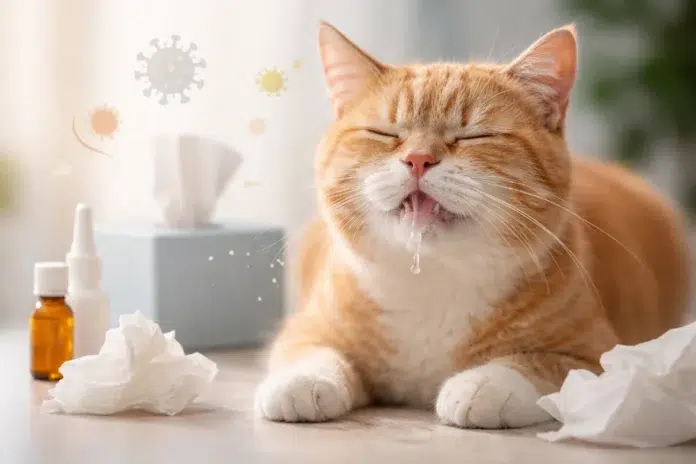
If your cat is sneezing a lot and you have also noticed a runny nose, it is easy to wonder whether this is just a minor irritation or the start of something more serious. In many cases, Cat Sneezing a Lot is tied to an upper respiratory issue, but it can also be triggered by allergies, irritants in the home, dental disease, nasal inflammation, or even something stuck in the nose. The pattern matters, the discharge matters, and your cat’s behavior matters even more. As Cornell notes, respiratory infections in cats commonly cause sneezing along with clear or colored discharge from the eyes or nose.
A single sneeze here and there is not unusual. Cats, like people, can react to dust, perfume, litter particles, or a sudden tickle in the nasal passages. But when sneezing becomes frequent and a runny nose joins the picture, it usually means there is inflammation somewhere in the upper airway, especially around the nose, throat, or sinus area. Veterinary sources consistently point to viral upper respiratory disease as one of the most common reasons for this combination of signs.
The tricky part is that not every cat looks obviously sick at first. Some still eat, still nap in their usual spot, and still come to the door when they hear food. Others go downhill quickly. That is why the smartest approach is not to panic, but also not to dismiss ongoing sneezing and nasal discharge as “just a cold.”
Why sneezing and a runny nose often show up together
Sneezing is a protective reflex. It happens when the lining of the nose or nasopharynx gets irritated. A runny nose, on the other hand, tells you there is discharge forming because those tissues are inflamed, infected, or reacting to something in the environment. Merck describes sneezing as a nonspecific sign that can occur with infectious, inflammatory, foreign-body, and even tumor-related problems, while rhinitis in cats commonly shows up with nasal discharge, tears, and facial irritation.
That is why the color and consistency of the discharge matter. Clear discharge can show up early in a viral infection or with irritation. Thicker mucus, yellow discharge, or pus-like drainage can suggest a secondary bacterial component or more advanced inflammation. Merck and VCA both note that clear discharge may become mucus-like or thicker over time, especially when inflammation persists.
The most common reason: upper respiratory infection
If a cat sneezing a lot and has a dripping nose, the most likely explanation is an upper respiratory infection. This is especially common in kittens, recently adopted cats, shelter cats, or cats living in multi-cat homes. Cornell explains that respiratory infections are common in cats and are especially common in high-density populations such as shelters and breeding environments.
Two major viral causes show up again and again in veterinary literature: feline herpesvirus type 1 and feline calicivirus. These infections can produce sneezing, nasal congestion, eye discharge, fever, lethargy, and reduced appetite. Merck notes that feline viral rhinotracheitis often begins with frequent sneezing, inflamed eyes, and a nose discharge that may start clear and then become more mucous-heavy or purulent. Cornell’s calicivirus information also describes cold-like signs, including sneezing, nasal congestion, fever, and discharge from the eyes and nose.
This is one reason cat owners sometimes say, “My cat looks like it has a cold.” That comparison makes sense on the surface, but feline respiratory infections are not always mild, and they are not something to self-diagnose for too long.
Signs that point toward an upper respiratory infection
You are more likely to be dealing with an infection if sneezing and nasal discharge come with other symptoms such as:
- watery or gunky eyes
- congestion or noisy breathing through the nose
- lower energy than usual
- reduced appetite
- mouth ulcers or drooling
- fever or obvious discomfort
Cornell, Merck, and VCA all describe this larger cluster of upper respiratory signs, with calicivirus in particular being linked to mouth ulcers in some cats.
It may be irritation, not infection
Not every sneeze means a virus. Some cats react strongly to the air in their home. Dusty litter, aerosol sprays, cigarette smoke, carpet powder, cleaning chemicals, perfume, incense, and even renovation dust can irritate the nasal lining enough to trigger repeated sneezing and some nasal discharge. VCA lists air-borne irritants such as powder, dust, fumes, smoke, and aerosol sprays among possible causes of sneezing and nasal discharge, and ASPCA notes that inhaled household products can cause mild respiratory irritation with sneezing and a runny nose.
This kind of sneezing often starts suddenly after something in the environment changes. Maybe you switched litter. Maybe a room was cleaned with a stronger product. Maybe air fresheners went up around the house. In those cases, the discharge is often clear, and the cat may otherwise seem normal.
Still, irritation is not always easy to separate from infection at home. A cat can start with one and end up with the other, especially if the nasal tissue stays inflamed.
Chronic rhinitis and sinus problems
Sometimes the issue is not a short infection but an ongoing inflammatory condition. Chronic upper respiratory disease and chronic rhinitis can leave cats with lasting sneezing, congestion, and nasal discharge even after the first infection has passed. VCA notes that a runny or stuffed-up nose is the most common sign in cats with chronic upper respiratory infections, and the discharge may be thick, yellow, blood-tinged, or brown. Merck likewise describes chronic rhinitis as sneezing that may be frequent or may come and go over time.
This can be frustrating for owners because the cat may seem to improve, then flare again. Stress, poor ventilation, and flare-ups of latent viral disease can all contribute. In real life, this is why some cats become known in the household as the one that is “always a little stuffed up.”
Dental disease can sometimes be the hidden cause
This surprises many people, but a runny nose is not always just a nose problem. Disease affecting the roots of the upper teeth can sometimes irritate nearby structures and contribute to discharge, sneezing, or chronic nasal issues. Veterinary sources on chronic nasal disease note that persistent discharge can have deeper causes and may need imaging or a full oral exam when it does not clear up.
This possibility becomes more important if your cat also has bad breath, drooling, trouble chewing, or prefers soft food. In an older cat, dental disease moves much higher on the list of likely contributors.
Could something be stuck in the nose?
Yes, although it is less common than infection. Plant material, dust particles, or other foreign matter can get lodged in the nasal passage and trigger sneezing fits. VCA includes foreign material as a possible cause of sneezing and discharge.
When that happens, the sneezing may come on suddenly and dramatically. Some cats paw at the face, shake the head, or sneeze over and over in a burst. If the problem is only on one side, you might notice discharge from one nostril more than the other. That asymmetry can be a useful clue.
Polyps, growths, and other structural problems
In young cats, nasopharyngeal polyps are one possibility. Cornell notes that upper respiratory signs such as sneezing, nasal discharge, noisy breathing, and difficulty swallowing can be linked to these growths.
In older cats, chronic one-sided discharge, facial swelling, or symptoms that steadily worsen may prompt a veterinarian to look for masses, tumors, or more serious nasal disease. Merck notes that a runny nose and sneezing can also point to tumors or foreign objects in persistent cases.
This is one reason duration matters. A mild viral infection may settle with time and proper care. A structural problem tends to linger, recur, or worsen.
When the discharge color tells you something useful
Color is not a perfect diagnostic tool, but it can still help you decide how urgent the problem may be.
| Nasal discharge | What it may suggest |
|---|---|
| Clear and watery | Early infection, mild irritation, or inflammation |
| White or cloudy | Mucus and ongoing nasal inflammation |
| Yellow or green | Infection or secondary bacterial involvement |
| Red-tinged | Irritation, trauma, severe inflammation, or bleeding |
| Brown or foul-smelling | Chronic disease, old blood, or more serious infection |
Veterinary references from Merck and VCA support the general pattern that clear discharge may become mucoid or mucopurulent as inflammation worsens or secondary infection develops.
The smell matters too. A strong odor is never something to ignore.
What to watch besides the sneezing
If you are trying to decide whether this can wait for a routine appointment or needs faster attention, look at the whole cat, not just the nose.
Pay attention to:
- appetite
- water intake
- energy level
- breathing effort
- eye discharge
- mouth ulcers
- drooling
- whether one or both nostrils are affected
- how long the symptoms have lasted
One of the biggest practical concerns is appetite. Cats rely heavily on smell to feel interested in food, so a blocked or irritated nose can make them eat less. VCA notes that poor appetite and weight loss are common in cats with chronic upper respiratory disease because smell is so important to eating.
If your cat is sneezing but still eating, grooming, and acting comfortable, that is reassuring. It does not rule out illness, but it lowers the urgency a little. If your cat stops eating, hides, becomes lethargic, or seems to struggle for air, the situation changes fast.
When you should call the vet
A cat that keeps sneezing with a runny nose should be seen by a veterinarian if symptoms are lasting, getting worse, or coming with signs that suggest more than simple irritation. Cornell and VCA both emphasize that breathing difficulty is not a problem to manage at home.
You should arrange veterinary care sooner rather than later if your cat has:
- symptoms lasting more than several days
- thick yellow, green, or bloody discharge
- appetite loss
- low energy or hiding
- eye discharge or swollen eyes
- mouth sores or drooling
- frequent recurrence of the same problem
- discharge from only one nostril
- weight loss
- bad breath with nasal signs
And this is an emergency if your cat has open-mouth breathing, panting, blue or gray gums, obvious respiratory distress, or cannot breathe comfortably. Cornell advises getting a cat to a veterinarian right away any time there is doubt about its ability to breathe comfortably, and VCA states that open-mouth breathing in cats needs immediate veterinary attention.
What a veterinarian may do
A vet visit for sneezing and a runny nose is often more straightforward than owners expect. The veterinarian will usually start with a physical exam, ask how long the symptoms have been present, and look at the eyes, mouth, teeth, temperature, and breathing.
Depending on the case, testing may include:
- an oral exam for dental disease
- nasal and eye assessment
- imaging such as x-rays or advanced scans in chronic cases
- swabs or infectious disease testing in selected patients
- sedation for a more complete nasal or oral examination in complicated cases
Merck notes that persistent cases may require additional examination such as x-rays, computed tomography, endoscopy, or tissue sampling when the cause is not obvious.
That may sound like a lot, but most cats do not need the full workup on day one. Many just need a proper exam, supportive care, and close follow-up.
What you can do at home safely
There are a few sensible things owners can do while waiting for an appointment or managing a mild case under veterinary advice.
First, keep the environment calm and clean. Remove strong fragrances, smoking, aerosol sprays, and dusty products from the area your cat uses most. If you recently changed litter and the timing matches the sneezing, switch back to a low-dust unscented option.
Second, encourage eating. Warm food slightly to make it smell stronger. Because nasal congestion can reduce appetite, this simple step can make a real difference. VCA specifically notes how important smell is to appetite in cats with nasal disease.
Third, gently wipe away visible nasal discharge with a soft damp cloth if your cat tolerates it. Avoid using human cold medications, essential oils, or random over-the-counter products. Those can make matters worse or even be dangerous.
A little humidity may help some congested cats feel more comfortable, but it should never replace veterinary care if symptoms are persistent or severe. The goal at home is comfort and observation, not amateur treatment.
Can this be prevented?
You cannot prevent every cause of sneezing, but you can reduce risk. Vaccination has significantly lowered the incidence of severe respiratory disease, even though it has not eliminated the contagious organisms that cause it. Cornell makes this point clearly in its overview of feline respiratory infections.
Good prevention habits include keeping vaccinations current, reducing stress, avoiding overcrowding in multi-cat settings, using good ventilation, staying on top of dental care, and minimizing irritating household products. These steps are not dramatic, but they matter.
A common question from owners
One of the most common situations is the cat that sneezes a lot, has a little runny nose, but still acts mostly normal. That can happen in mild viral infections and in irritation-related cases. It can also be the early phase of something that gets worse later. Cornell and VCA both describe upper respiratory disease as something that may begin with signs like sneezing and discharge before appetite loss or more obvious illness becomes clear.
So the right response is not to assume the worst, but it is also not to ignore the trend. Watch duration, discharge, appetite, and breathing. Those four clues tell you a lot.
Final thoughts
When you notice Cat Sneezing a Lot along with a runny nose, the most likely cause is an upper respiratory problem, but that is not the whole story. Irritants, chronic rhinitis, dental disease, foreign material, polyps, and more serious nasal conditions can all look similar at first. The smartest thing you can do is pay attention to the details, especially how long it has been going on, what the discharge looks like, and whether your cat is still eating and breathing comfortably. Problems affecting the upper respiratory tract can start small and then become harder on a cat than they first appear.
Most mild cases are not a reason to panic. But repeated sneezing, colored discharge, poor appetite, or any breathing trouble should move this from “watch and wait” to “call the vet.” If Cat Sneezing a Lot is happening in your home right now, trust the pattern more than the guess. Cats are good at hiding discomfort, and early attention usually makes the road back much easier.
FAQ
Is it normal for a cat to sneeze a lot with a runny nose?
An occasional sneeze can be normal, but frequent sneezing with nasal discharge usually points to irritation, infection, or inflammation rather than something harmless. Veterinary references consistently treat ongoing discharge as a sign worth monitoring.
Can cat litter make a cat sneeze?
Yes. Dusty or scented litter can irritate the nose and trigger sneezing, especially in sensitive cats. Airborne irritants such as powder and fumes are recognized causes of nasal irritation.
Should I worry if my cat is sneezing but still eating?
It is less urgent if your cat is eating, alert, and breathing normally, but it still deserves attention if the sneezing keeps going, the discharge thickens, or new symptoms show up. Appetite can drop later as congestion worsens.
When is sneezing an emergency?
It becomes urgent if your cat has open-mouth breathing, panting, blue or gray gums, obvious breathing effort, or seems unable to rest comfortably. Those are emergency signs in cats.
Can a cat recover from an upper respiratory infection?
Many do, especially with timely care and good supportive management, but some cats develop chronic flare-ups or ongoing nasal issues. That is why recurrent symptoms should not be brushed off.

